U
doakaCollection
The Udoaka Collection spans six decades of Nigerian and West African art — from the 1940s oils of Aina Onabolu, the man who made Nigerian art possible, to the studios of painters working in Lagos today. It holds prints by Bruce Onobrakpeya, who at ninety-two remains the defining figure of Nigerian modernism, and canvases by artists whose names have never appeared in a catalogue. It includes a record-breaking Enwonwu alongside work by painters known only to the communities they paint for. It draws from every major school and tradition in the country's art history — from the Zaria rebels who decolonised the curriculum, to the Oshogbo experiment that bypassed it entirely; from the Auchi generation that remade Lagos's art scene in the 1990s, to the Ona movement's systematic recovery of Yoruba visual language. What unites these works is not a single aesthetic, a single period, or a single level of institutional recognition. It is the quality of the looking that acquired them.
The Artists
VIEW
VIEW ALL ARTISTS →Aina Onabolu/Ben Enwonwu/Akinola Lasekan/Erhabor Emokpae/Bruce Onobrakpeya/Muraina Oyelami/Abiodun Olaku/Kolade Oshinowo/Ablade Glover/Lemi Ghariokwu/Tola Wewe/Kainebi Osahenye/Ben Osaghae/Sam Ovraiti/Duke Asidere/Alex Nwokolo/Pita Ohiwere/Edosa Oguigo/George Edozie/Tega Akpokona/Emmanuel Mbanefo
Aina Onabolu
B. 1882, Ijebu-Ode, Nigeria. D. 1963
To stand before an Aina Onabolu portrait is to encounter the founding act of Nigerian modernity. Born in Ijebu-Ode in 1882, Onabolu was largely self-taught, learning the academic principles of Western painting from reproductions in colonial magazines before anyone thought to teach such things in Nigerian schools. That was precisely the point: in an era when colonial education officers insisted that the natural limit of African ability was pottery and craft, Onabolu sat quietly and produced portraits of such technical mastery that the argument collapsed under their own weight. He later trained at the Académie Julian in Paris and at St. John's Wood College in London, returning to Nigeria in 1922 to campaign successfully for the introduction of fine art into the school curriculum — a campaign whose principal instrument was Kenneth Murray, the English art teacher sent by the colonial education department to assist him. The artists Murray trained became Nigeria's first generation of formal art educators, and the tradition they established runs directly through nearly every painter in this collection. Known in Lagos as Mr. Perspective, Onabolu received the Medal of the Order of the British Empire in 1957 for services to fine arts education. The two works in the Udoaka Collection — oils from 1945 and 1946 — are among the final works of a man who, more than anyone, made it possible for Nigerian artists to exist.
The works by Aina Onabolu previously held in the Udoaka Collection have since been placed in private hands. His biography and selected works are preserved here as a record of his practice and as a resource for those exploring the breadth and history of West African art.
SELECTED WORKS
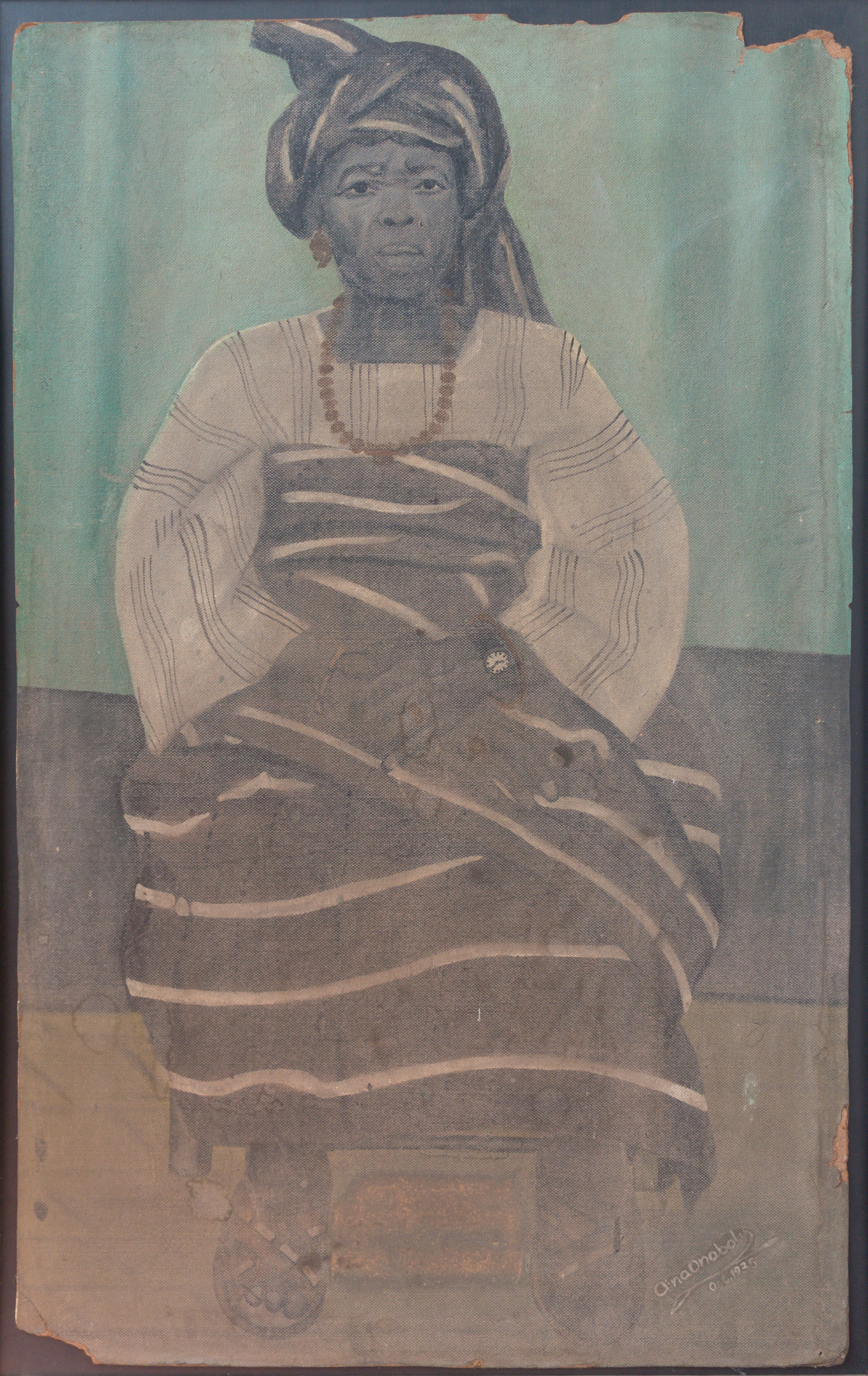
Untitled, 1935
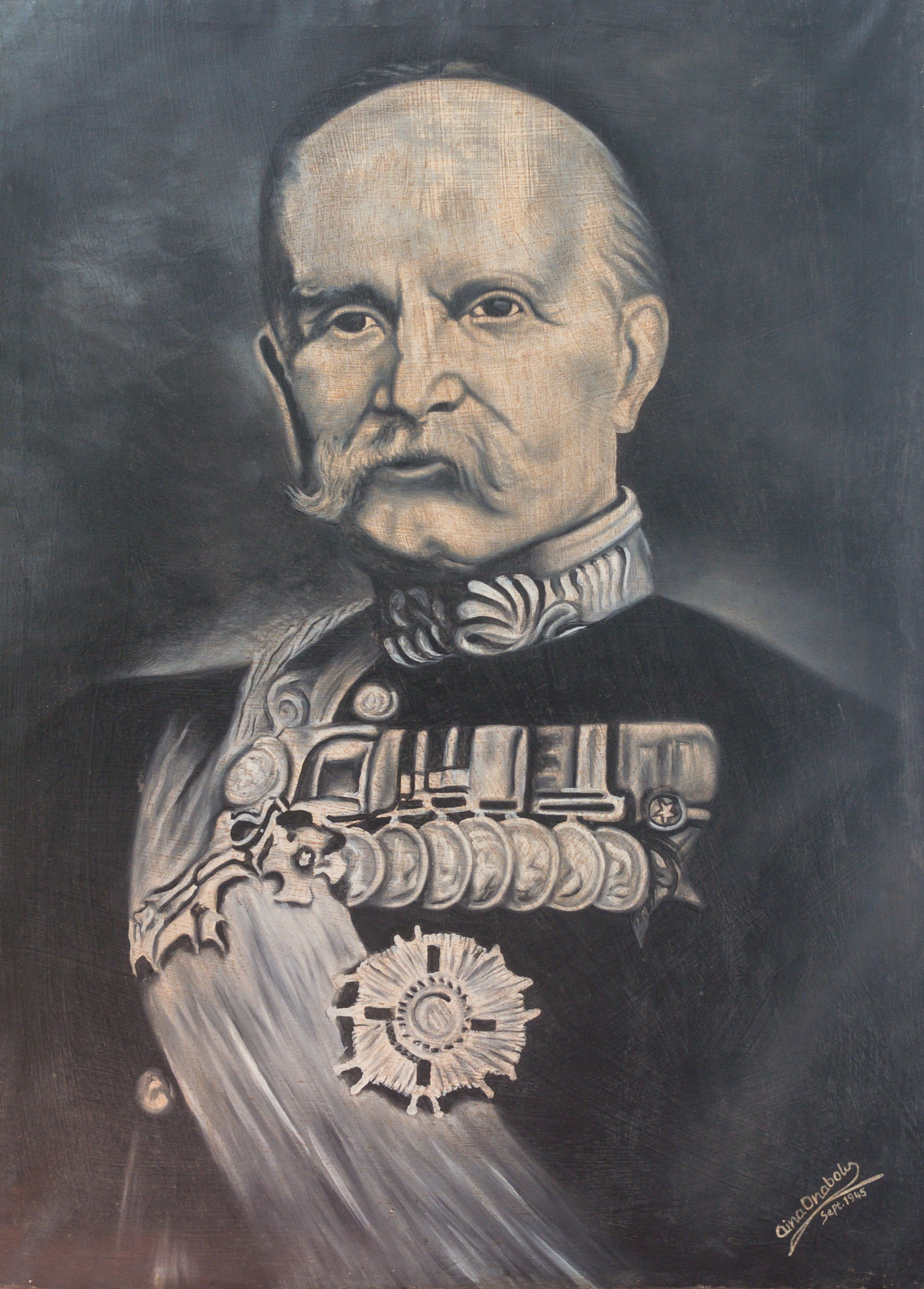
Untitled, 1945
SELECTED EXHIBITIONS
National Gallery of Modern Art, Lagos · Smithsonian Institution · Society of Nigerian Artists Hall of Fame (posthumous, 2018)
NOTABLE ACQUISITION
Medal of the Order of the British Empire, 1957 — for services to fine arts education in Nigeria
Ben Enwonwu
B. 1917, Onitsha, Nigeria. D. 1994
There is a painting that hung on the wall of every middle-class home in eastern Nigeria for a generation — a portrait of a Yoruba princess, serene and regal against a field of warm gold. Enwonwu painted Tutu in 1973, three years after the end of the Biafran War, as a deliberate act of reconciliation: an Igbo artist painting a Yoruba noblewoman at the precise moment the country needed to remember what it held in common. Born in Onitsha in 1917 into a family of traditional sculptors, he trained at the Slade School of Fine Art in London — the institution that also shaped a generation of British modernists — returning to Nigeria to become arguably the most influential African artist of the twentieth century. He sculpted a bronze portrait of Queen Elizabeth II in 1956 — the first African artist commissioned by the Crown — and his Anyanwu stands permanently at the United Nations headquarters in New York. A version of Tutu sold at Bonhams for £1.2 million in 2018, setting a record for modern Nigerian art.
The works by Ben Enwonwu previously held in the Udoaka Collection have since been placed in private hands. His biography and selected works are preserved here as a record of his practice and as a resource for those exploring the breadth and history of West African art.
SELECTED WORKS
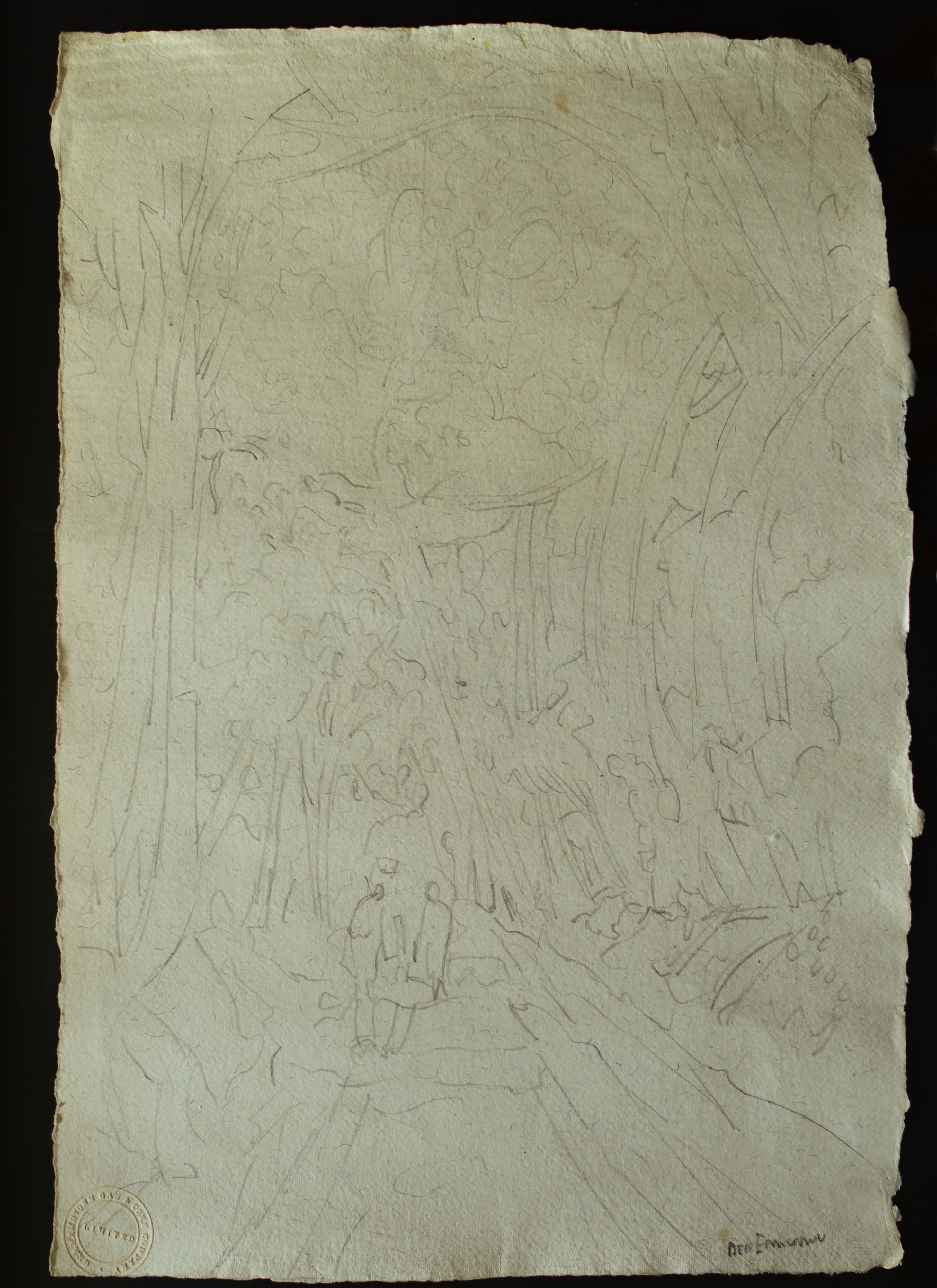
Untitled, Date unknown
SELECTED EXHIBITIONS
Tate Modern, London · Smithsonian National Museum of African Art · Bonhams, London · Frieze Masters, 2023
AUCTION RECORD
£1.2m — Bonhams London, 2018 (Tutu)
NOTABLE ACQUISITION
Anyanwu — United Nations Headquarters, New York · Anyanwu — Nigerian National Museum, Lagos
Akinola Lasekan
B. 1916, Nigeria. D. 1972
Akinola Lasekan fought two battles simultaneously, and won both. As a painter he was a naturalist of the first order — a portraitist of intense attention who captured the faces of politicians, professionals and ordinary Nigerians with what his contemporaries called an elegant and exact use of colour. As a cartoonist, he was Nigeria's first and, for a generation, most dangerous: the pen behind the political pages of the West African Pilot, the newspaper founded by Nnamdi Azikiwe as the primary instrument of the independence movement. Largely self-taught at first — he founded the Lash Studio Correspondence School in 1940, democratising art training when the colonial system denied it to most — Lasekan was also among the first group formally trained by Kenneth Murray under the Onabolu programme, and later joined the founding faculty of the School of Fine Arts at the University of Nigeria, Nsukka in 1961. The Nsukka school he helped establish would become one of the most important centres of contemporary Nigerian art, producing the tradition of uli-based practice later associated with artists like Obiora Udechukwu and Tayo Adenaike. Lasekan died in 1972, still insufficiently celebrated; his paintings are in the Nigerian National Gallery of Arts and in collections across the world.
The works by Akinola Lasekan previously held in the Udoaka Collection have since been placed in private hands. His biography and selected works are preserved here as a record of his practice and as a resource for those exploring the breadth and history of West African art.
SELECTED WORKS
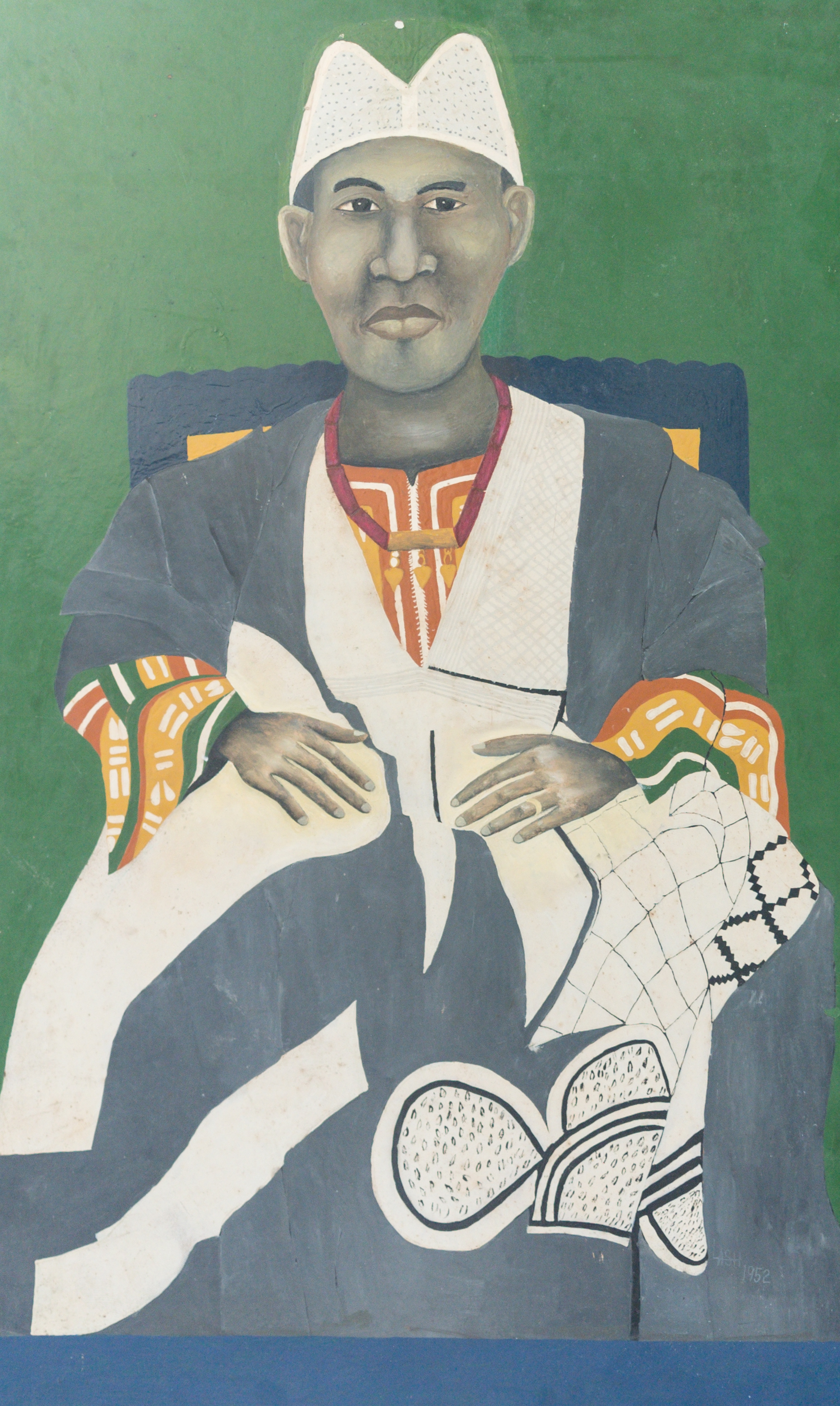
Untitled, 1952
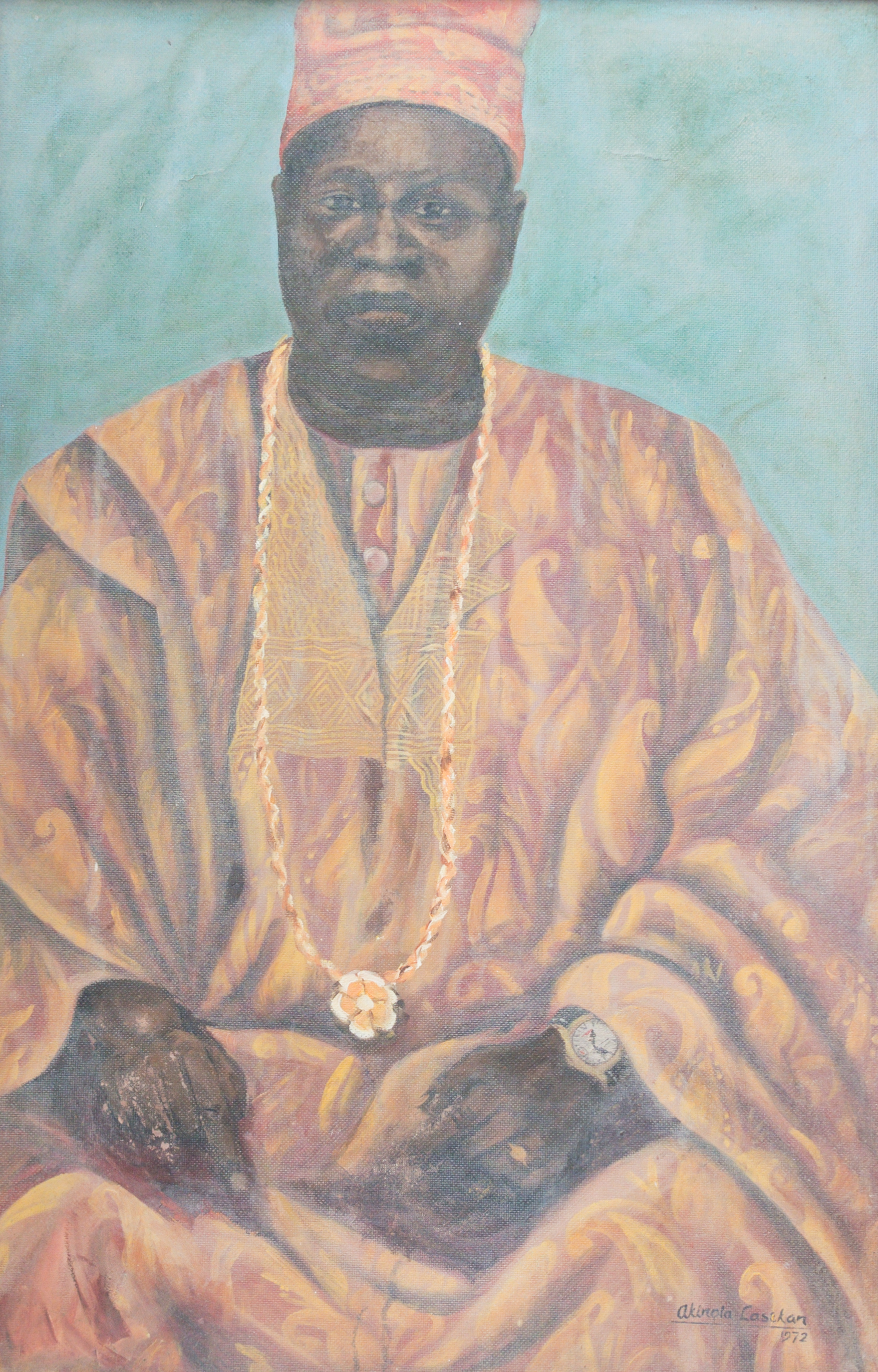
Untitled, 1972
SELECTED EXHIBITIONS
Terra Kulture, Lagos (retrospective, 2012) · FESTAC 77, Lagos · Smithsonian Institution
AUCTION RECORD
$51,532 — auction record (portrait)
NOTABLE ACQUISITION
Nigerian National Gallery of Arts, Lagos · University of Nigeria, Nsukka permanent collection
Erhabor Emokpae
B. 1934, Benin City, Nigeria. D. 1984
Erhabor Emokpae arrived at his practice from two directions at once: the Benin Guild of Carvers, whose bronzes and ivories had shaped his childhood eye, and the Federal Ministry of Information, where he spent his early career making art for the state. Neither sat easily with the other, and the tension between them — between inherited cosmology and the demands of the modern nation — became the engine of everything he made. Born in Benin City in 1934 and trained at the Yaba Technical Institute before studying in England in 1963, Emokpae was a founding member and secretary of the Society of Nigerian Artists in 1964 and a co-founder of the Lagos Arts Council — two institutions that gave shape to the professional infrastructure of Nigerian art. In 1973 he produced a bronze replica of the ivory mask of Queen Idia, which became the official emblem of FESTAC 77, and his decorations at the four entrances of the National Arts Theatre in Lagos remain permanent fixtures of the city's cultural landscape. He was awarded the Officer of the Order of the Niger in 1980. He died in Lagos in 1984 at forty-nine.
SELECTED WORKS
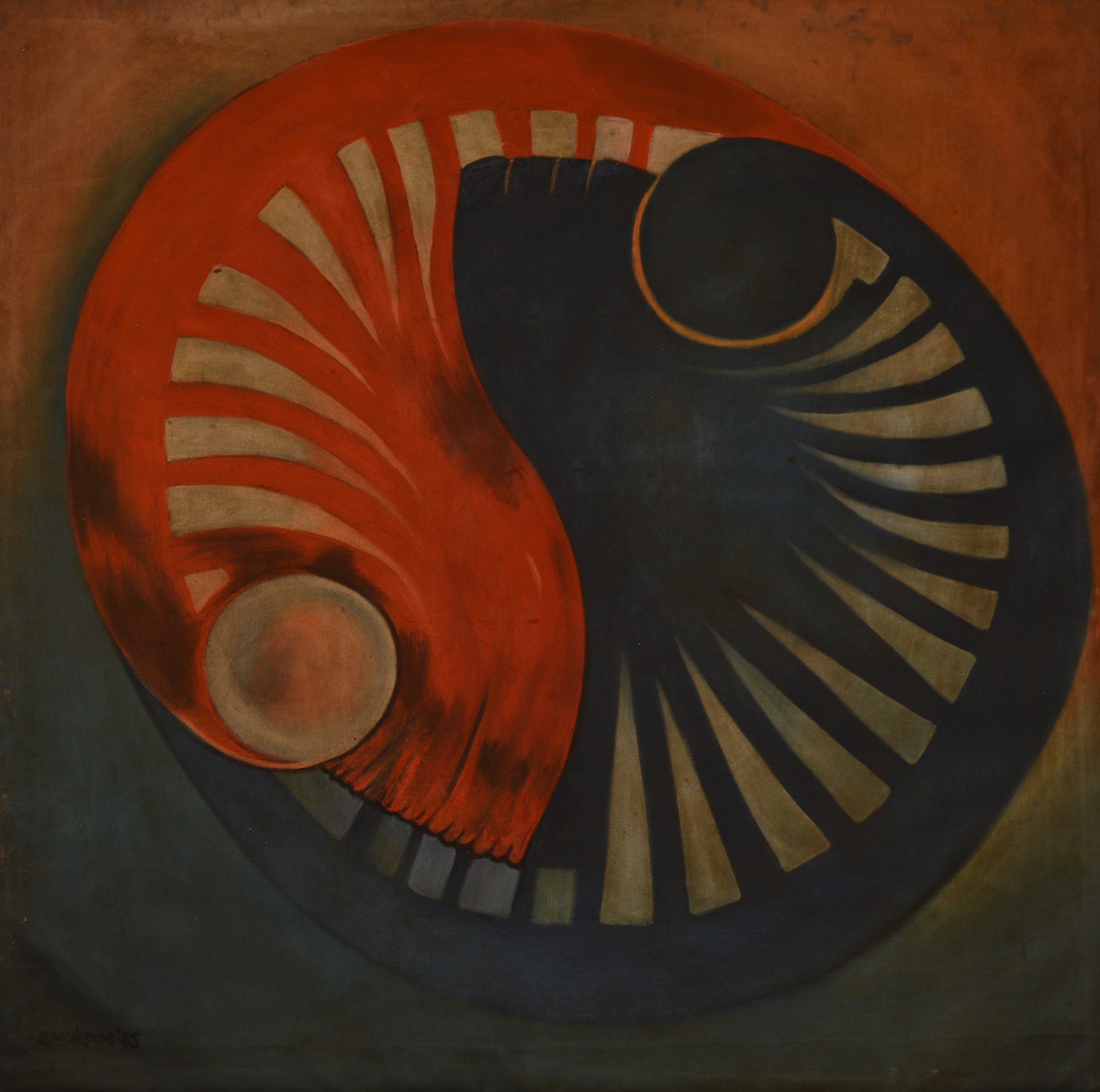
Untitled
SELECTED EXHIBITIONS
FESTAC 77, Lagos · Camden Art Centre, London · University of Ife Festival of the Arts · National Arts Theatre, Lagos (permanent installation)
AUCTION RECORD
$42,597 — Arthouse Contemporary, 2008 (The King and The Queen)
NOTABLE ACQUISITION
Officer of the Order of the Niger, 1980 · FESTAC 77 emblem · National Arts Theatre decorations, Lagos (permanent)
Bruce Onobrakpeya
B. 1932, Agbarha-Otor, Nigeria
The marks Bruce Onobrakpeya makes on metal, paper and canvas carry the weight of an entire philosophical project. Born in 1932 in the Delta State, Onobrakpeya trained at the Nigerian College of Arts, Science and Technology in Zaria, where in 1958 he co-founded the Zaria Art Society — the group that called themselves the Zaria Rebels and committed themselves to decolonising the visual arts curriculum they had inherited from the colonial administration. Their principle was natural synthesis: a deliberate fusing of African artistic tradition with Western technique, proposed at a moment when the colonial art establishment still insisted these were incompatible. Onobrakpeya became the movement's most enduring practitioner, developing entirely new printmaking techniques — including his signature plastograph and metal foil works — that drew on Urhobo cosmology, masquerade iconography and Christian symbolism simultaneously. He later founded the Harmattan Workshop in Agbarha-Otor, an annual gathering that has shaped the practice of several artists in this collection. At ninety-two, he remains a defining figure in Nigerian modernism and received the UNESCO Living Human Treasures Award in 2006.
SELECTED WORKS
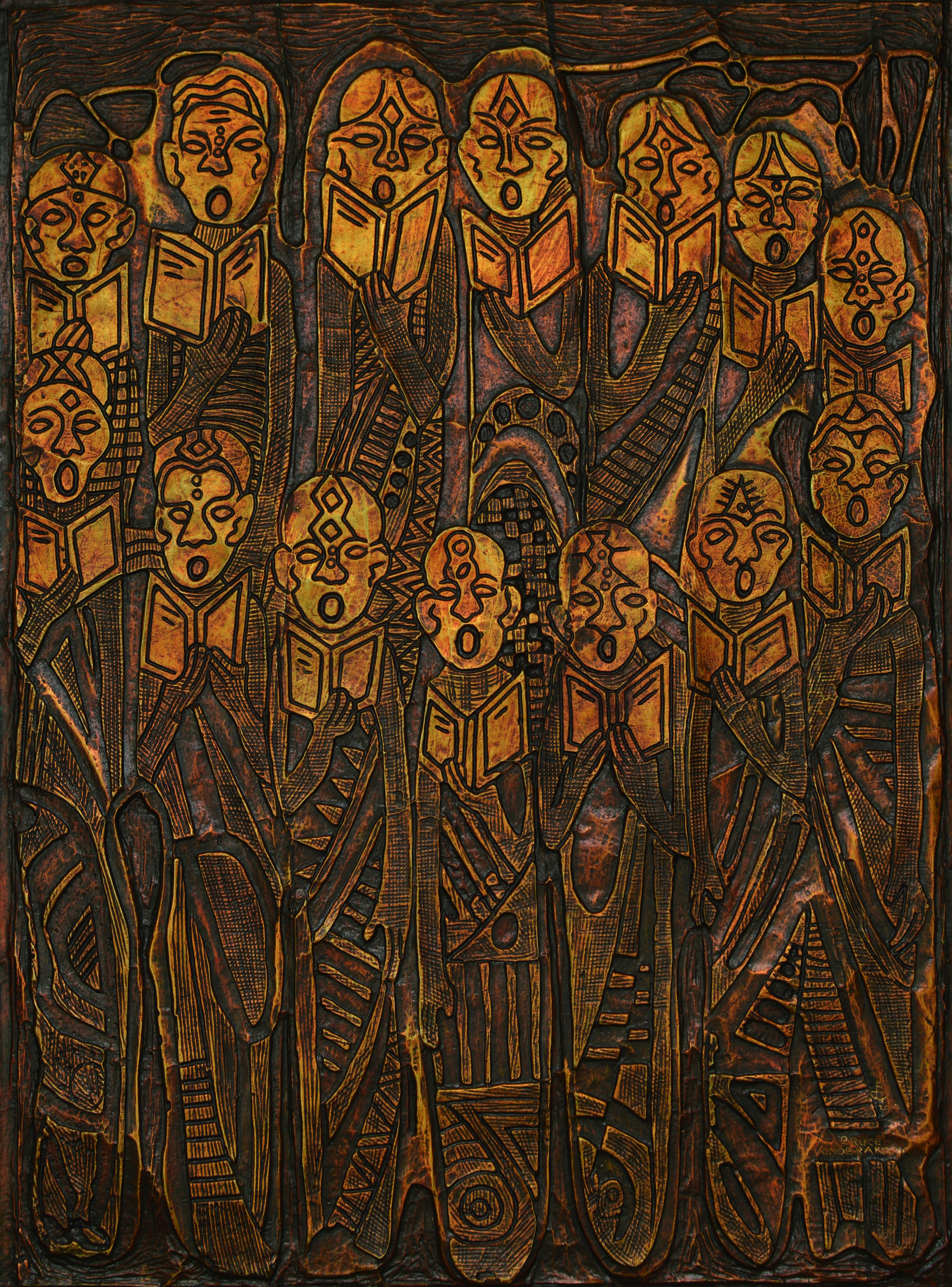
Kuaya (Choir) IV, 2013
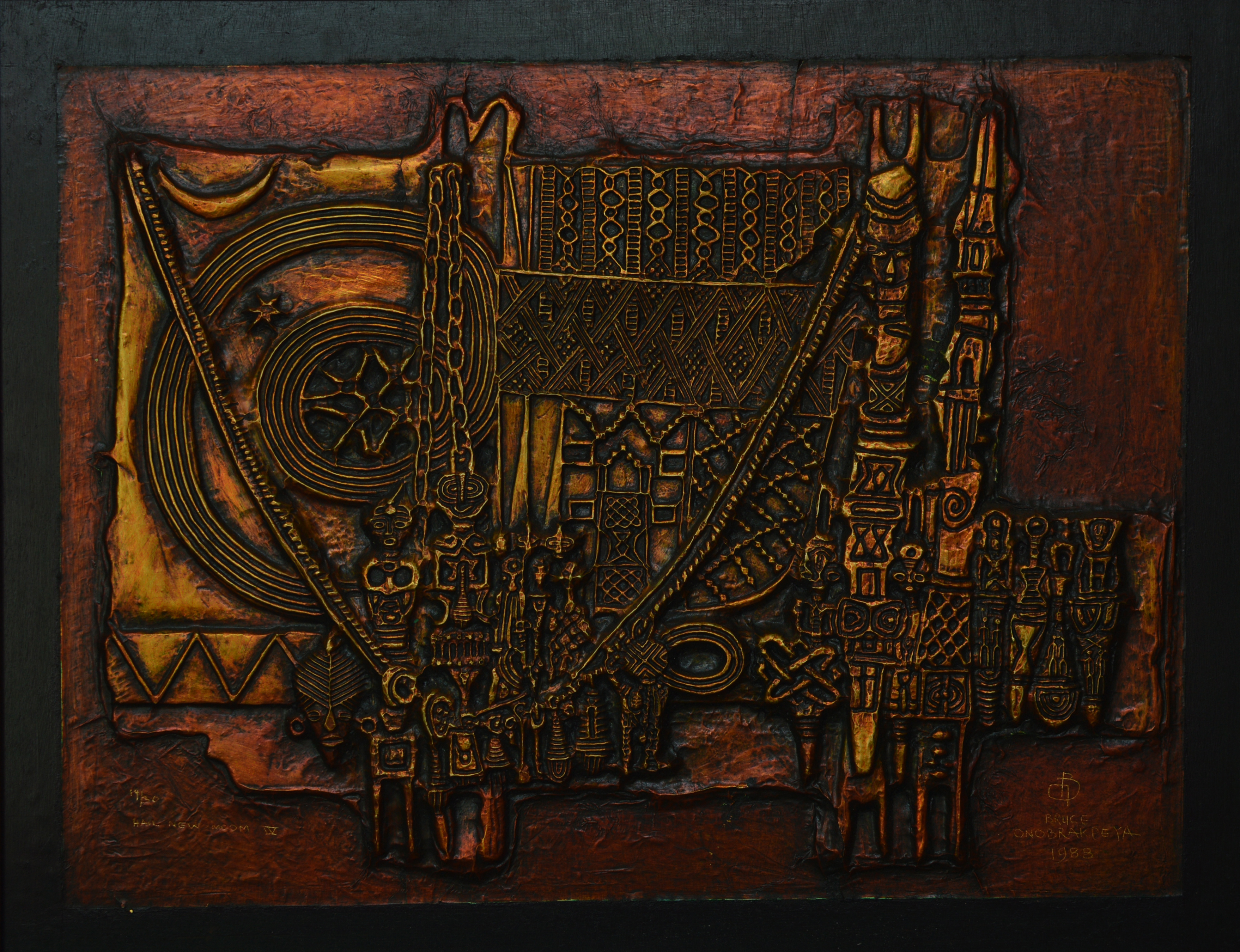
Hail New Moon IV, 1988
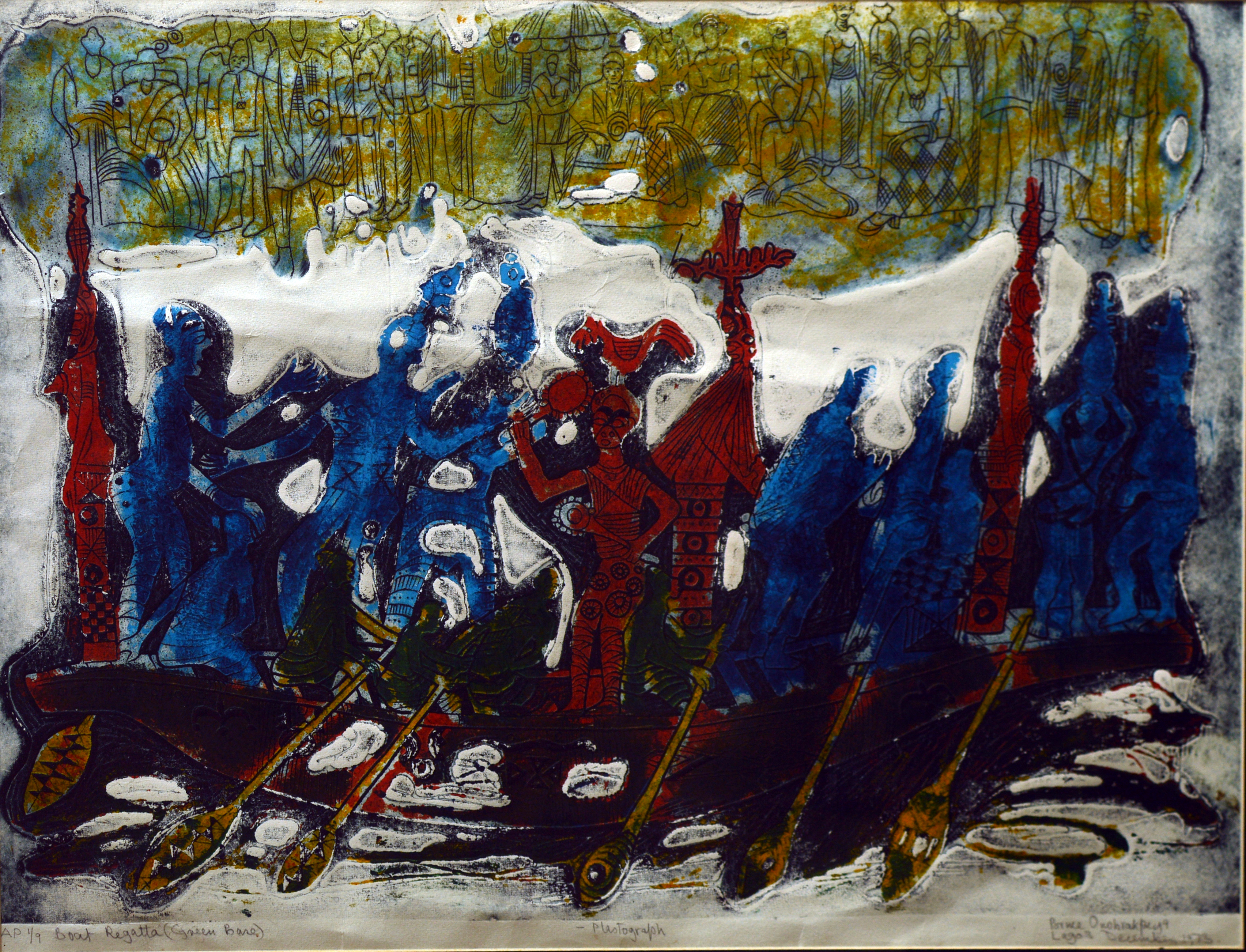
Boat Regatha, 1973
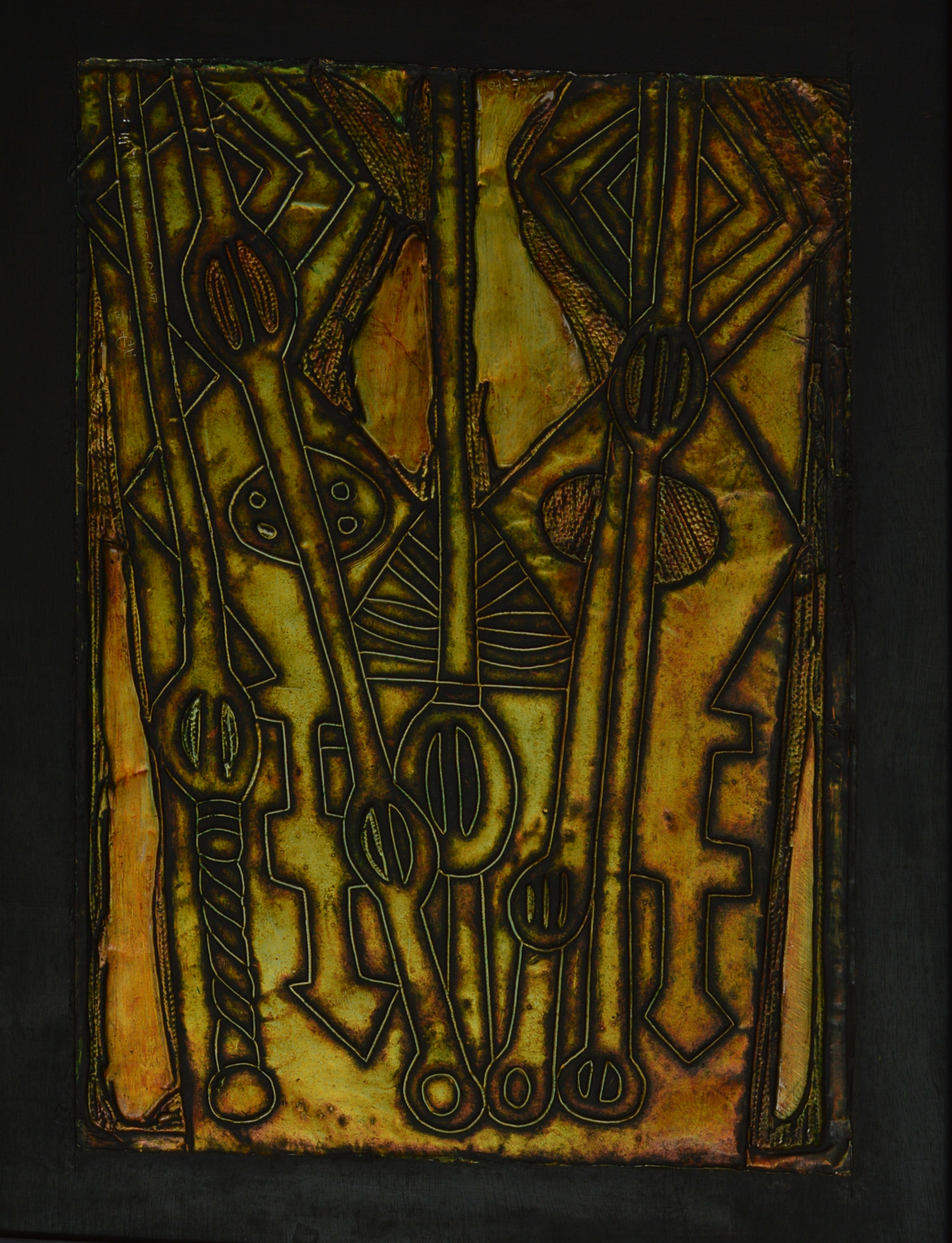
Ibiekpo
SELECTED EXHIBITIONS
Tate Modern, London · Venice Biennale, 1990 · Smithsonian National Museum of African Art, 2024
NOTABLE ACQUISITION
UNESCO Living Human Treasures Award, 2006 · Works in the Vatican Museum, Rome
Muraina Oyelami
B. 1940, Iragbiji, Nigeria
Muraina Oyelami came to painting the way the Oshogbo experiment intended: sideways, through performance, without the interference of formal training. Born in Iragbiji in 1940, he was already a master dundun and bata drummer and an actor in Duro Ladipo's theatre company when, in 1964, he attended the Mbari Mbayo workshop in Osogbo run by Ulli and Georgina Beier. The workshop's premise was simple and radical: take young Nigerians steeped in Yoruba culture and let them paint, without teaching them to paint like Europeans. The Oshogbo School that emerged from these workshops — which also produced Twins Seven-Seven, Jimoh Buraimoh and Adebisi Fabunmi — became one of the most internationally recognised movements in twentieth-century African art. What emerged from Oyelami's hand in particular was a body of work that early Western reviewers compared to Modigliani and Klee — a comparison he found curious, as he had not seen their work. His figures are dense with Yoruba cosmology: masked ancestors, ceremonial gatherings, folktale landscapes rendered in bold line and colour that has gradually deepened into a more introspective palette. He taught traditional music and dance at Obafemi Awolowo University from 1976 to 1987, was made Eesa of his hometown Iragbiji in 1993, and in 2018 founded the Abeni Visual and Performing Art Institute. His works are in the Smithsonian, the Studio Museum Harlem and the IWALEWA-Haus in Germany.
SELECTED WORKS
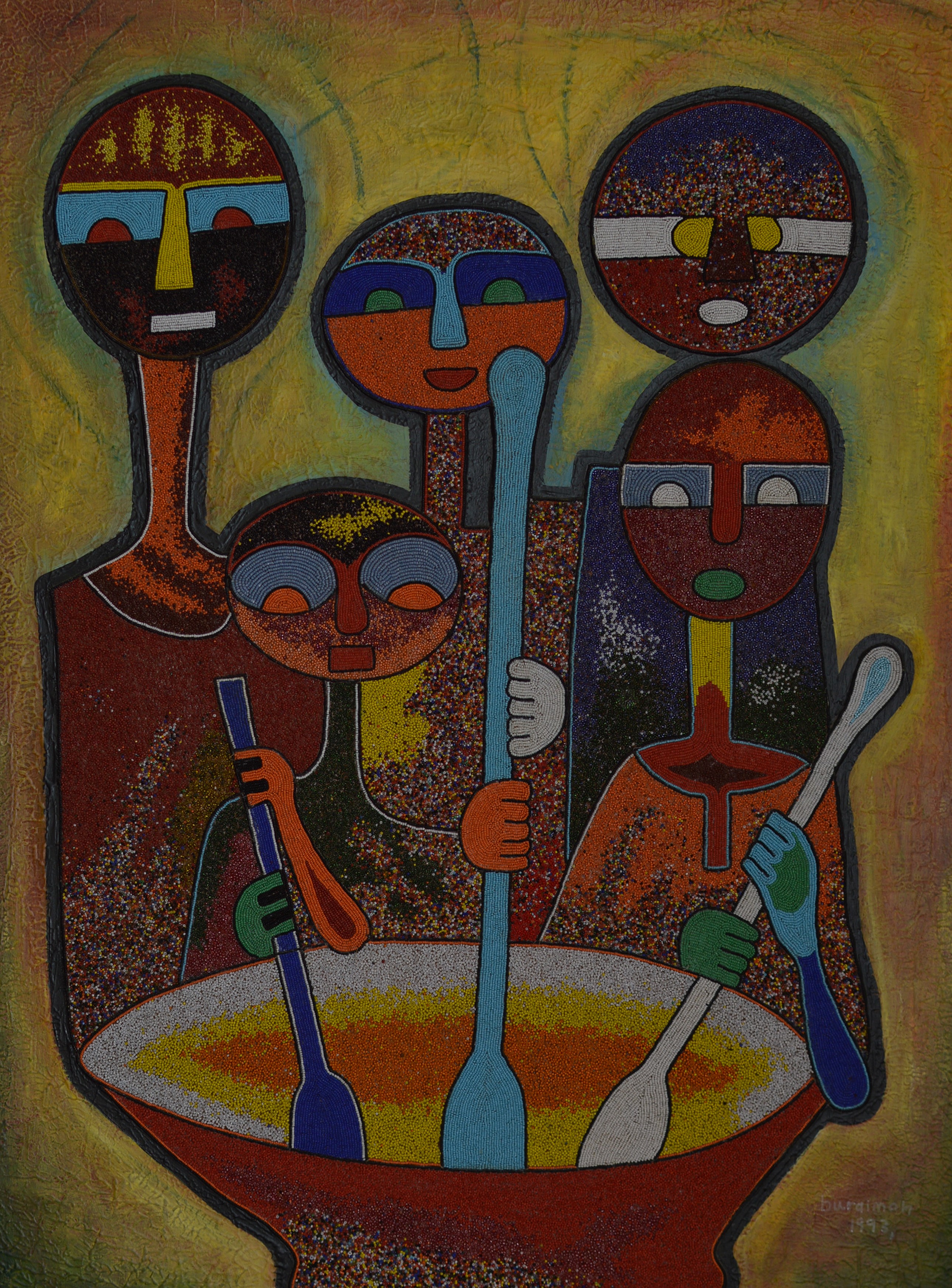
Untitled
SELECTED EXHIBITIONS
Smithsonian National Museum of African Art, Washington DC · Studio Museum Harlem, New York · Staatliche Kunsthalle, Berlin · Institute of Contemporary Arts, London
NOTABLE ACQUISITION
Smithsonian National Museum of African Art, Washington DC · IWALEWA-Haus, Bayreuth, Germany · Studio Museum Harlem, New York
Abiodun Olaku
B. 1958, Lagos, Nigeria
Abiodun Olaku paints darkness the way other artists paint light — as something active, structural, full of information. Born in Lagos in 1958 and trained at Yaba College of Technology under Professor Yusuf Grillo and Kolade Oshinowo — two of the defining figures of Nigerian painting — he became a full-time studio artist in 1984. Yaba College of Technology, where Grillo had built one of the country's most rigorous painting departments, produced a lineage of artists committed to observation, craftsmanship and the mastery of light; Olaku is its most distinguished living heir. His paintings of Lagos at dusk — lorry parks, waterways, market edges, city streets dissolving into evening — are lit from within by small persistent sources: a window, a brazier, the backlights of a vehicle. The critic Frank Ugiomoh has called him a bridge between the old masters of Nigerian art and its current generation. He is co-founder of Universal Studios of Art at the National Theatre, Lagos, and received the Nigerian National Order of Merit in 2011. His 2024 retrospective Odyssey at the National Museum Lagos, his first solo in twenty years, was among the most anticipated exhibitions on the Lagos art circuit in recent memory.
The works by Abiodun Olaku previously held in the Udoaka Collection have since been placed in private hands. His biography and selected works are preserved here as a record of his practice and as a resource for those exploring the breadth and history of West African art.
SELECTED WORKS
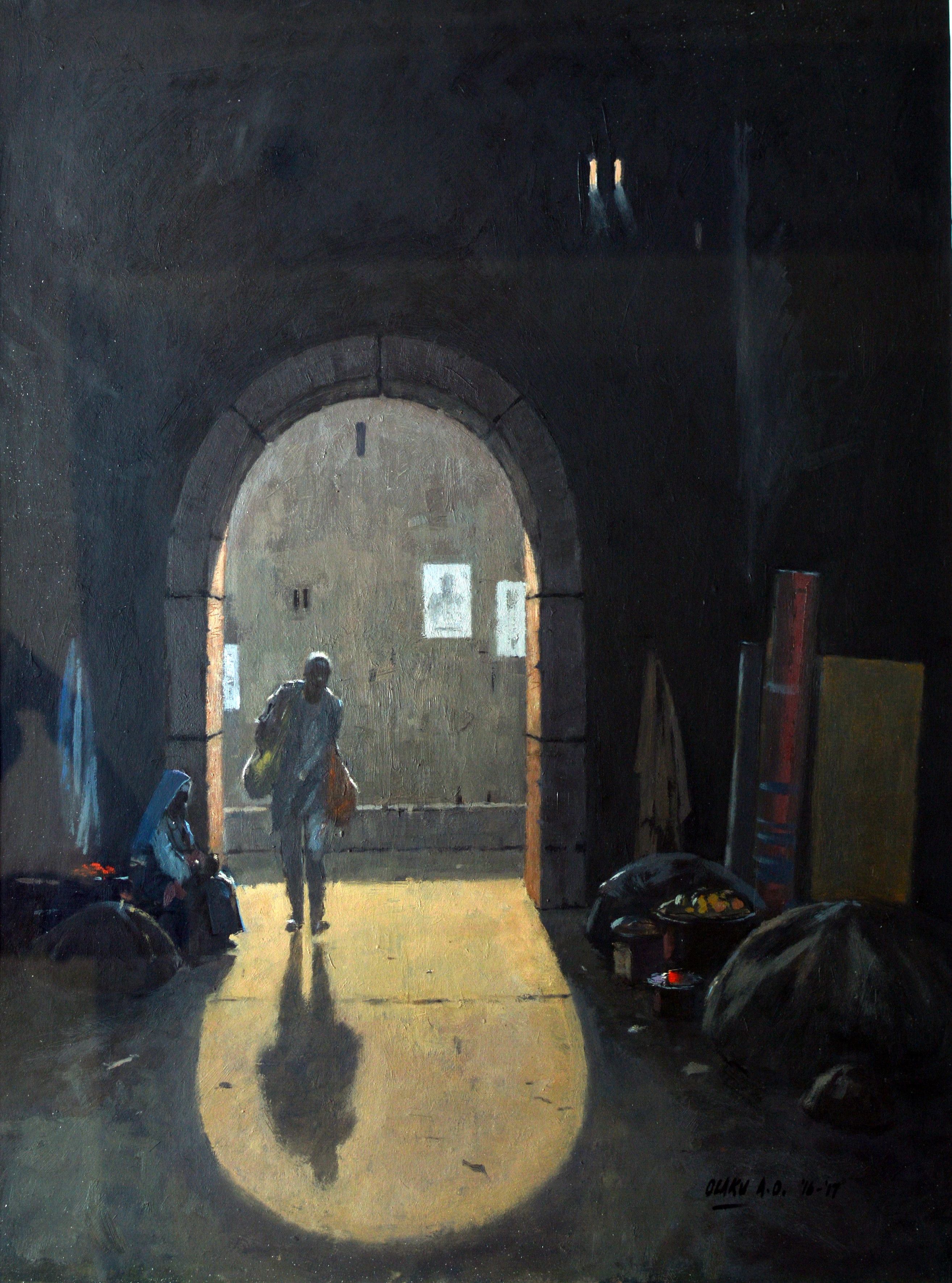
Untitled
SELECTED EXHIBITIONS
National Museum Onikan, Lagos (Odyssey, 2024) · Terra Kulture, Lagos (Stimulus, 2004) · Yemisi Shyllon Museum of Art, Lagos
NOTABLE ACQUISITION
Nigerian National Order of Merit (NNOM) Award, 2011 · Private collections in Nigeria, UK and USA
Kolade Oshinowo
B. 1948, Ibadan, Nigeria
Kolade Oshinowo is the painter of Nigerian civic life — its markets and ceremonies, its crowds and its women, its ordinary grandeur observed with patience and without sentiment. Born in Ibadan in 1948 and trained at Ahmadu Bello University in Zaria, graduating in 1972, his student years were shaped by the long shadow of the Zaria Art Society — the Rebels who a decade earlier had committed themselves to decolonising the visual arts curriculum — and by the trauma of a civil war that had just ended. After teaching briefly at King's College Lagos, he joined Yaba College of Technology in 1974, eventually serving as head of the Fine Arts department, director of the School of Art, Design and Printing, and deputy rector. In this role he became one of the central figures in the Yaba lineage — training a generation of painters that included Abiodun Olaku, who also holds a place in this collection. He served as president of the Society of Nigerian Artists from 2005 to 2008, was inducted into its Hall of Fame in 2018, and in later work began introducing fabric and textile into his painted surfaces, connecting his canvases directly to Nigeria's material culture.
SELECTED WORKS
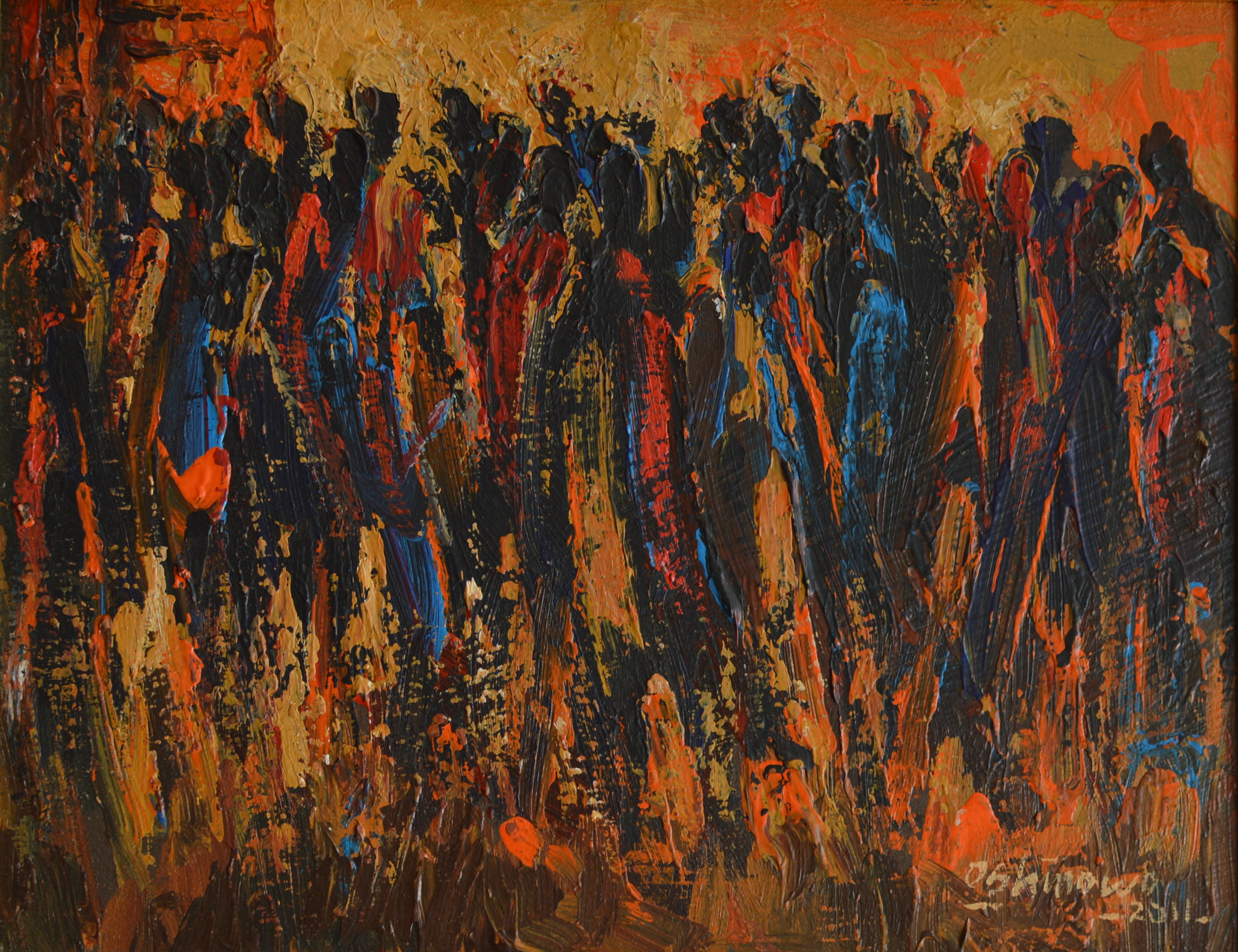
Untitled
SELECTED EXHIBITIONS
Goethe Institut, Lagos · FESTAC 77, Lagos · National Museum touring exhibition · Society of Nigerian Artists Hall of Fame, 2018
NOTABLE ACQUISITION
Society of Nigerian Artists Hall of Fame, 2018 · Works in private and public collections in Nigeria, USSR, Cuba, Romania and India
Ablade Glover
B. 1934, Accra, Ghana
Stand close to an Ablade Glover painting and you see nothing but thick impasto — great furrows of pigment pushed by a palette knife into a surface that is more excavation than application. Step back, and a market assembles itself: the bright gele of a trader, the crush of a lorry park, the deep canopy of a forest. Glover was born in Accra in 1934 and came of age as Ghana won independence in 1957 — a moment that framed his entire career. He trained at Kumasi's College of Art, at London's Central School of Art and Design, at Newcastle University, and earned a doctorate at Ohio State University, returning each time to Ghana to teach, eventually for twenty years at the Kwame Nkrumah University of Science and Technology. In this he mirrors the generation of Nigerian artists — Onabolu, Enwonwu, Emokpae — who built the infrastructure of West African modernism through the double commitment of making and teaching. In 1995 he founded the Artists Alliance Gallery in Accra, opened formally by Kofi Annan, which has sustained a generation of Ghanaian artists. His work is in the collections of UNESCO in Paris, the Imperial Palace of Japan, and O'Hare International Airport in Chicago. Bonhams London has called him one of the fathers of modern African art.
SELECTED WORKS
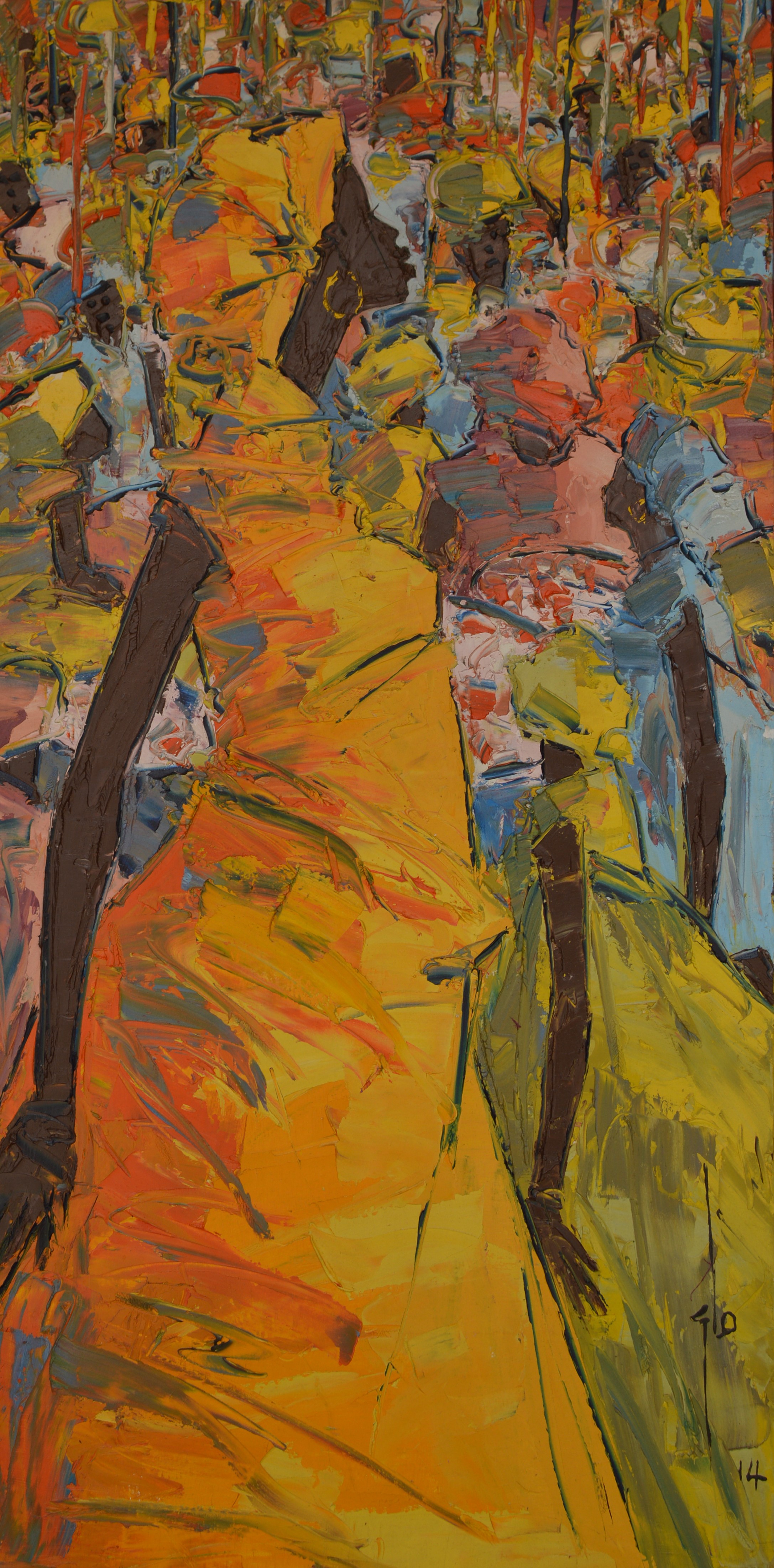
Untitled
SELECTED EXHIBITIONS
October Gallery, London (since 1982, nine solo exhibitions) · Sotheby's, London · Bonhams, London · Gallery 1957, Accra
NOTABLE ACQUISITION
UNESCO headquarters, Paris · Imperial Palace of Japan · O'Hare International Airport, Chicago · Order of the Volta (Ghana) · Fellow of the Royal Society of Arts (FRSA)
Lemi Ghariokwu
B. 1955, Lagos, Nigeria
There is a genre of art — urgent, popular, politically unambiguous — that the fine art world has not always known what to do with. Lemi Ghariokwu has spent fifty years making it anyway. Born in Agege, Lagos in 1955 and entirely self-taught — part of a counter-tradition in Nigerian art that runs from Onabolu through the Oshogbo painters to the present, in which formal schooling was bypassed or rejected in favour of direct practice — he first encountered Fela Kuti in 1974 through a chance meeting with a journalist who had seen a poster Ghariokwu drew of Bruce Lee for a local bar. Within weeks he had designed Alagbon Close, Fela's furious response to a police beating, and the collaboration that followed produced twenty-six album covers over two decades: Zombie, Yellow Fever, Sorrow Tears and Blood, Beasts of No Nation. Christened simply The Artist by Fela himself, Ghariokwu worked in a mixture of oil painting, collage, illustration and caricature that channelled the music's anti-establishment rage into images of startling visual force. He refused payment for the covers, accepting instead a document giving him free entry to all Fela's concerts. His 2002 painting Anoda Sistem is in the permanent collection of the Museum of Modern Art in New York.
SELECTED WORKS
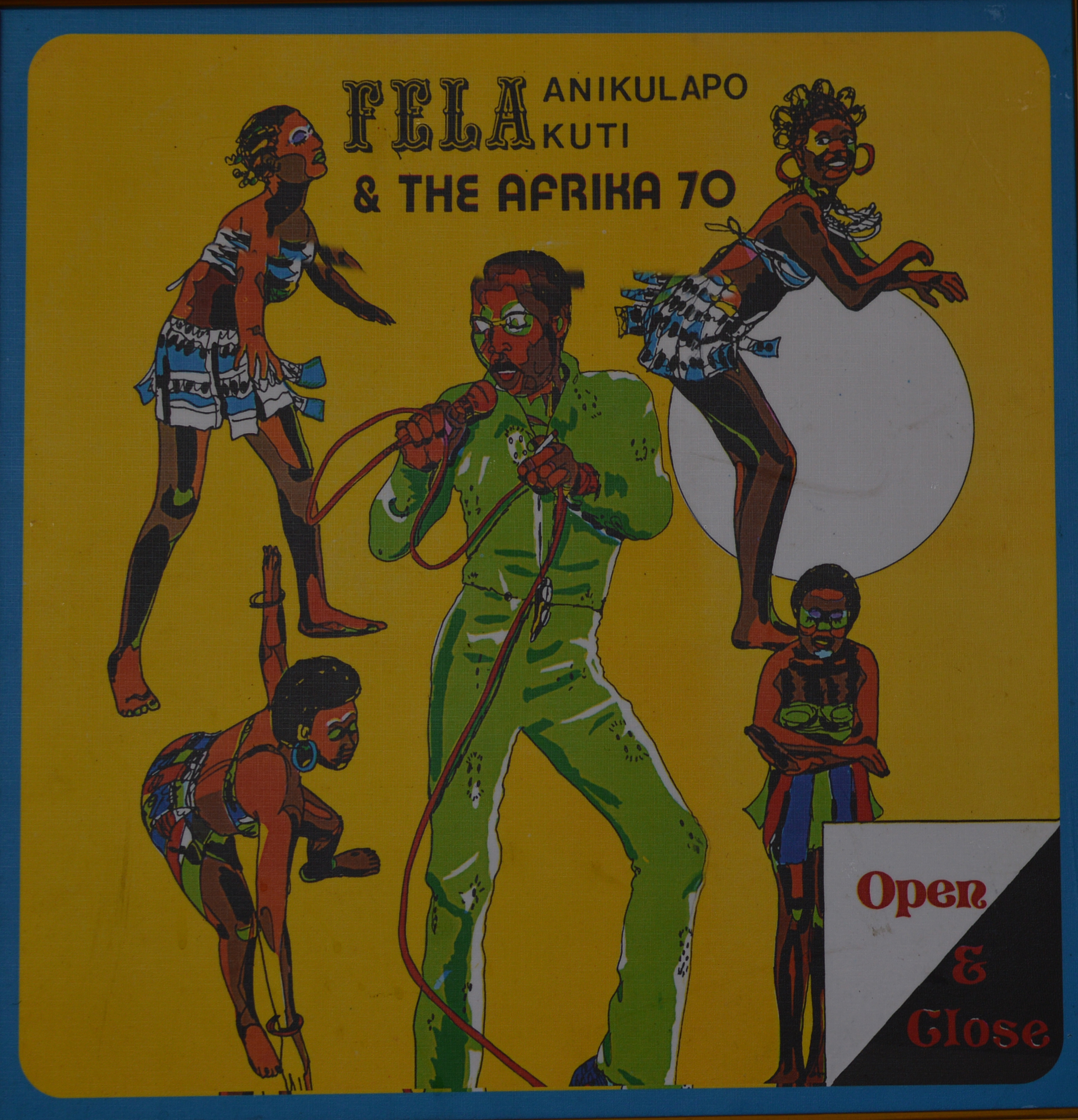
Untitled
SELECTED EXHIBITIONS
Centre for Contemporary Art, Lagos · Museum of Modern Art (MoMA), New York (permanent collection) · October Gallery, London
NOTABLE ACQUISITION
Anoda Sistem, 2002 — Museum of Modern Art (MoMA), New York (permanent collection) · Phaidon's list of 100 most influential graphic designers in the world
Tola Wewe
B. 1959, Okitipupa, Nigeria
Tola Wewe describes himself not as an author but as a witness — a vehicle through which the anjonnu, emere and ebora, the invisible presences of Yoruba tradition, make themselves visible on canvas. Born in Okitipupa, Ondo State in 1959, he trained at the University of Ife under the Ife school tradition — one of Nigeria's three great art school lineages alongside Zaria and Yaba — graduating in Fine Art in 1983, then took a Master's degree in African Visual Arts at the University of Ibadan in 1986. His MA research on the Ijaw water spirit mask opened a vein of inquiry into the symbolic languages of the Niger Delta and the Yoruba southwest that has never left his work. A founding member of the Ona movement — the group of artists, scholars and critics who emerged in 1989 committed to the systematic adaptation and reinterpretation of traditional Yoruba symbol and form — Wewe brings Ona symbols, ancestral myth and folkloric narrative together in paintings of layered surface texture and unusual chromatic intensity. He later served as Commissioner of Tourism and Culture in Ondo State. A monograph by Professor Moyo Okediji, Metamodern Vision of Tola Wewe, was published in his honour.
SELECTED WORKS
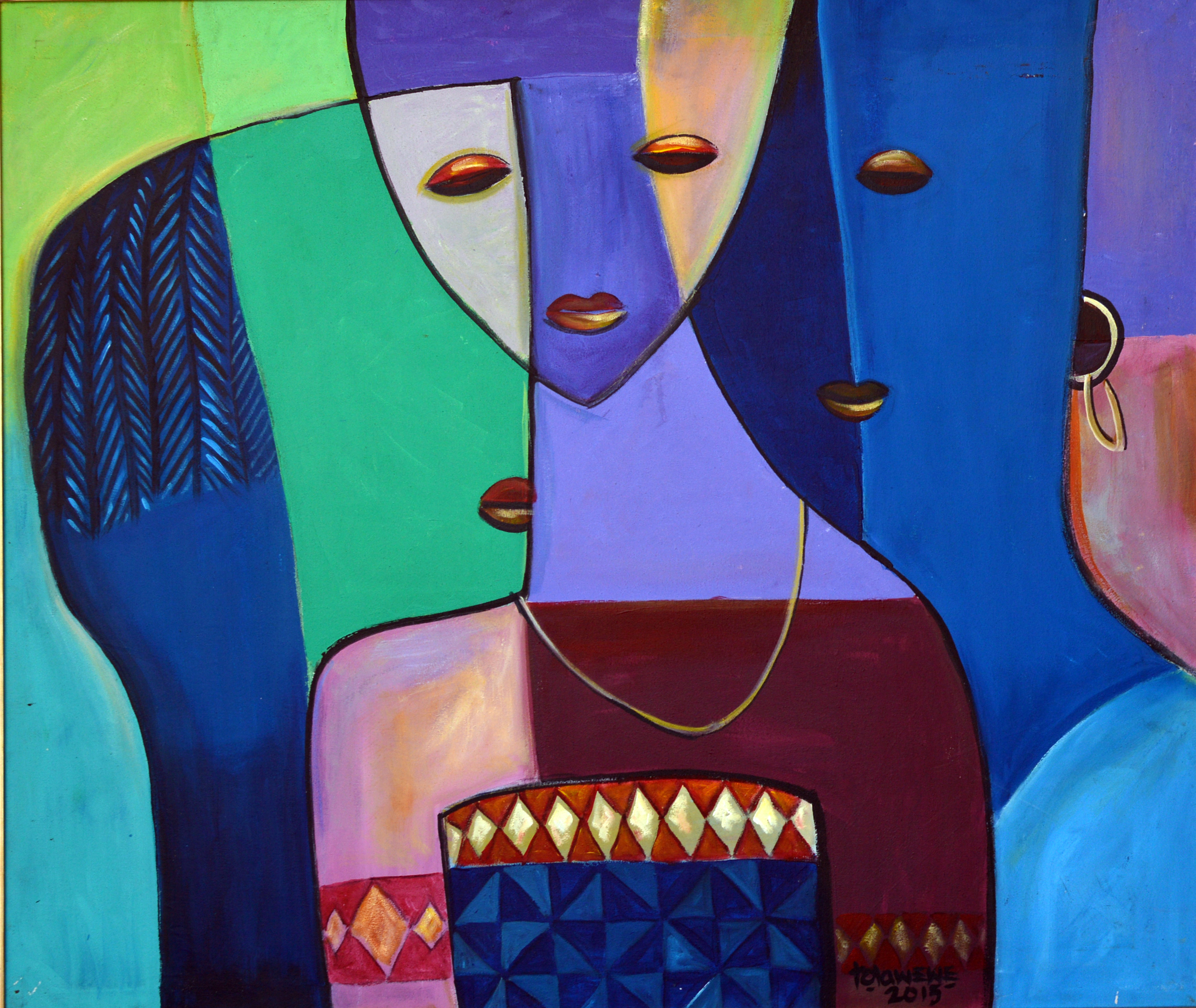
Untitled
SELECTED EXHIBITIONS
Arthouse Contemporary, Lagos · Artcurial, Paris · Roseberys, London · Private collections in Nigeria, UK and France
NOTABLE ACQUISITION
Commissioner of Tourism and Culture, Ondo State · Monograph: Metamodern Vision of Tola Wewe, Prof. Moyo Okediji
Kainebi Osahenye
B. 1964, Agbor, Nigeria
Kainebi Osahenye began as a painter and became something harder to name. Born in Agbor, Delta State in 1964, he trained at Auchi Polytechnic — the Federal Polytechnic in Edo State that during the 1980s and early 1990s became one of the most generative art schools in Nigeria, producing a generation of painters that reshaped the Lagos art scene — and at Yaba College of Technology, graduating in painting in 1989. He later completed an MFA at Goldsmiths in London in 2012. Over three decades he has expanded steadily outward from the canvas into installation, assemblage and photography, driven by a consistent preoccupation with man's inhumanity to man. His first major exhibition, Tears in Our Time, shown at the Nigerian Institute of International Affairs in 1991, established the thematic territory he has never really left. His best-known installation, Redemption, uses thousands of burnt and crushed aluminium cans collected from a hotel yard in Auchi, stacked and sequenced into a work that transforms industrial refuse into something close to testimony. Osahenye has shown at Bonhams, Philips de Pury, the Johannesburg Art Fair and Skoto Gallery New York.
SELECTED WORKS
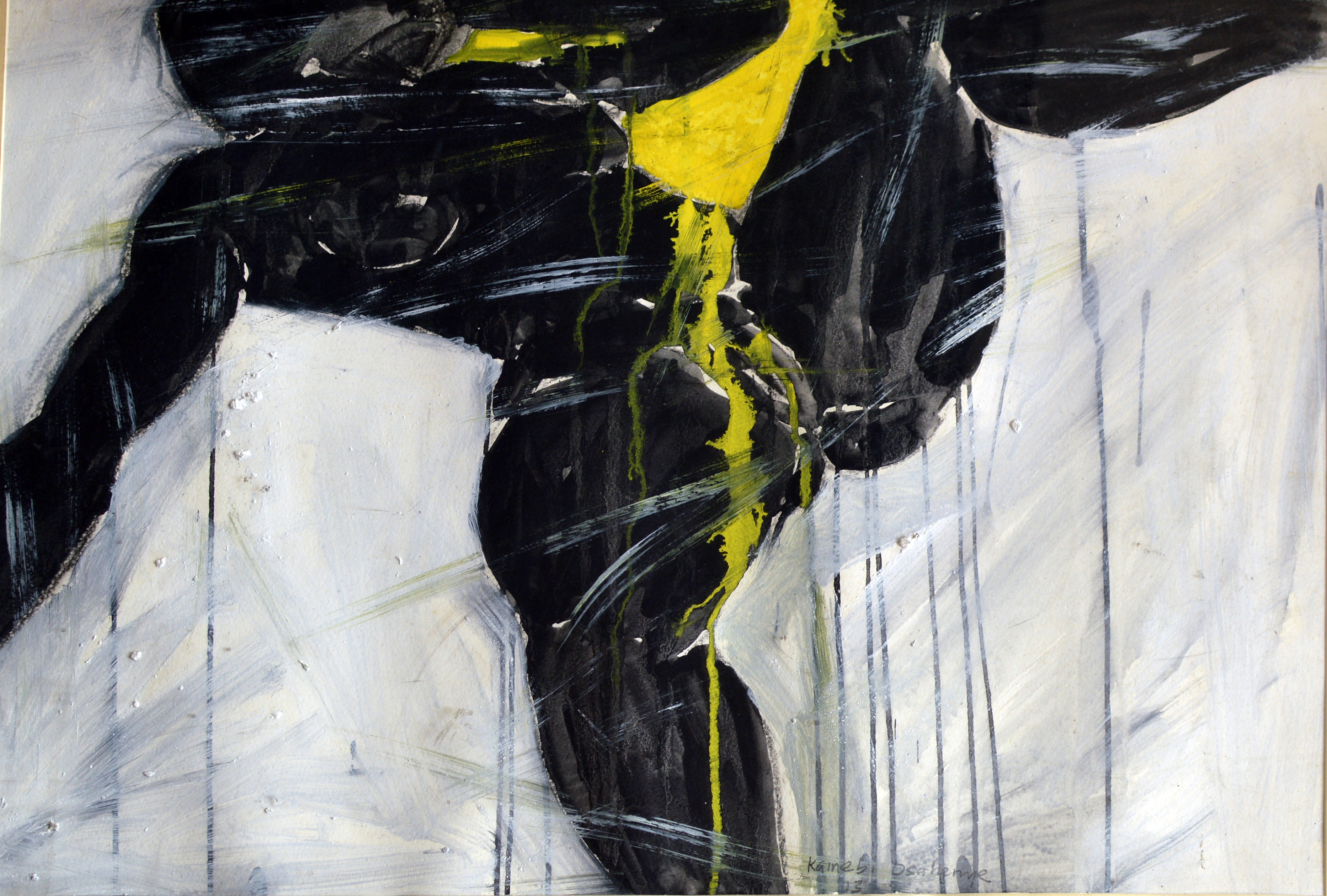
Untitled
SELECTED EXHIBITIONS
Centre for Contemporary Art, Lagos · Nigerian National Museum, Lagos (Shifting Currents) · Johannesburg Art Fair · Skoto Gallery, New York · Art X Lagos, 2016
NOTABLE ACQUISITION
MFA, Goldsmiths College, London, 2012 · Private collections in Nigeria, UK and USA
Ben Osaghae
B. 1962, Benin City, Nigeria. D. 2017
Ben Osaghae painted from memory. The scenes of Lagos life that fill his canvases — the bus parks, the arguments, the gatherings, the small human dramas of a city under continuous pressure — were reconstructed entirely from what he had absorbed and retained. The art critic Jess Castellote called him probably the most gifted draughtsman Nigeria had in recent times and, above all, a storyteller whose images are never quite direct: there is always an ambiguity, a metaphorical gap between what is painted and what is meant. Born in Benin City in 1962 and trained at Auchi Polytechnic — where he was part of the remarkable generation that included Sam Ovraiti, Duke Asidere, Alex Nwokolo and Pita Ohiwerei — he taught at his alma mater until 1995, when he resigned to paint full time in Lagos. This Auchi generation collectively transformed the Lagos art scene in the early 1990s with their colour-saturated, expressionistically charged work. Osaghae was the most restrained of them, the most interior. He was the most collected Nigerian artist of his generation in Lagos private collections, and was the subject of a joint monograph by Jess Castellote and Akinyemi Adetunji. He died in Lagos in January 2017.
SELECTED WORKS
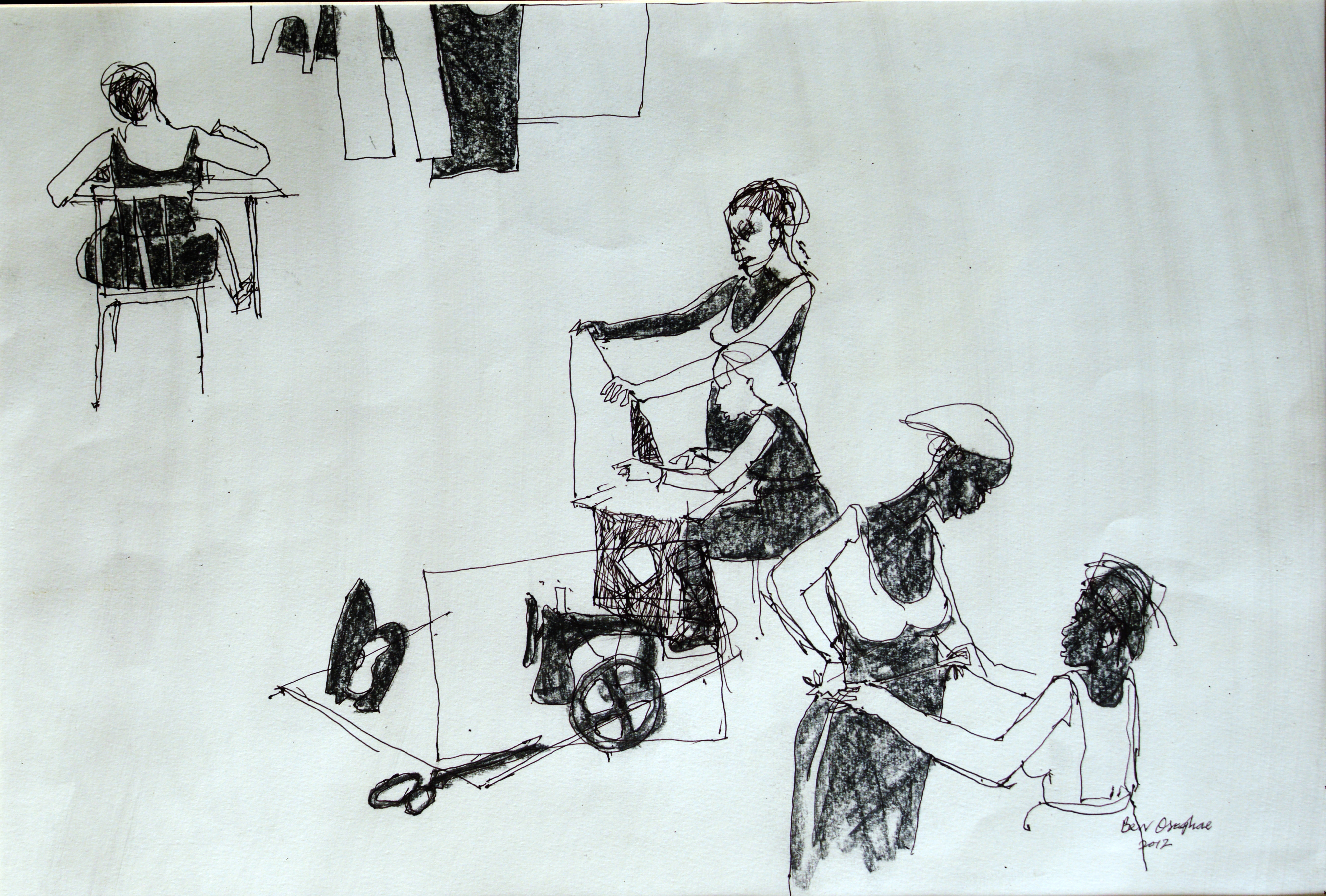
Untitled
SELECTED EXHIBITIONS
Sotheby's, London · Benin Art Gallery (retrospective, 2025) · Widely collected in Lagos private collections
NOTABLE ACQUISITION
Most represented artist in Nigerian Contemporary Art in Lagos Private Collections (2012) · Monograph: Ben Osaghae — Visual Chronicles of a Society in Flux
Sam Ovraiti
B. 1961, Zaria, Nigeria
Sam Ovraiti's early reputation rested on watercolour — a medium he pursued with such commitment at the Federal Polytechnic, Auchi in the 1980s that he is credited with helping to establish it as a serious painting medium within the Nigerian art community at a time when oils dominated. Born in Zaria in 1961, he graduated from Auchi in 1983 and taught there until 1993, becoming a central figure in the school's exceptional cohort — a generation that included Duke Asidere, Ben Osaghae, Alex Nwokolo and Pita Ohiwerei, and whose collective debut in Lagos with the exhibition Visions in Colour in 1990 changed the temperature of the city's art world. The Auchi school, as it became known, was characterised by expressionistic naturalism and an unusual relationship to colour — not the earth tones associated with Nigerian painting, but something dreamlike and chromatic. Ovraiti was its most committed colour theorist. He left Auchi for Lagos in 1993, moved progressively from watercolour into oils and mixed media, and has maintained a long association with Bruce Onobrakpeya's Harmattan Workshop, of which he is now artistic director. He received the Society of Nigerian Artists' Master Artist Award in 2018.
SELECTED WORKS
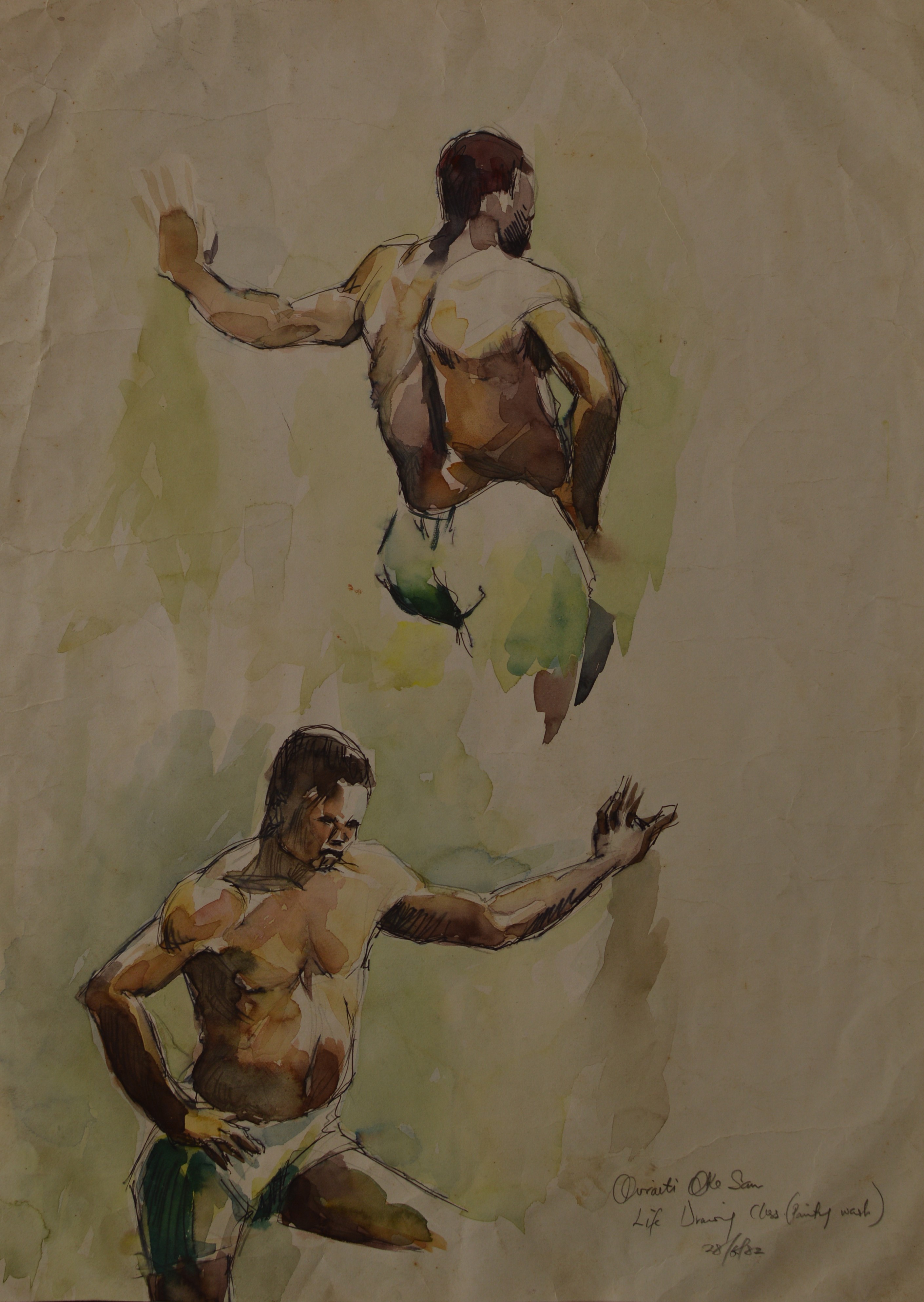
Untitled
SELECTED EXHIBITIONS
Alexis Gallery, Lagos · Harmattan Workshop, Agbarha-Otor · Arthouse Contemporary, Lagos
NOTABLE ACQUISITION
Society of Nigerian Artists Master Artist Award, 2018 · Artistic Director, Harmattan Workshop
Duke Asidere
B. 1961, Lagos, Nigeria
Duke Asidere graduated from Ahmadu Bello University, Zaria in 1988 with a first-class degree in painting — the same institution where, thirty years earlier, the Zaria Art Society had proposed the decolonisation of Nigerian art education. He stayed on for a Master's degree, then joined the Federal Polytechnic, Auchi in 1990, entering the remarkable circle of painters gathered there — Ben Osaghae, Sam Ovraiti, Alex Nwokolo — who were collectively making Auchi one of the most energetic nodes in contemporary Nigerian art. He was mentored by Bruce Onobrakpeya and shaped decisively by Gani Odutokun, and both influences are visible in his work: the first in its commitment to a symbolic visual language rooted in Nigerian tradition, the second in the intellectual rigour of its formal construction. In 1995 he moved to Lagos for full-time studio practice. His paintings use the human figure — sometimes headless, sometimes limbless, sometimes multiplied across dense urban compositions — as a vehicle for social and political commentary, rendered with the economy of line and the irony that are his most recognisable qualities.
SELECTED WORKS
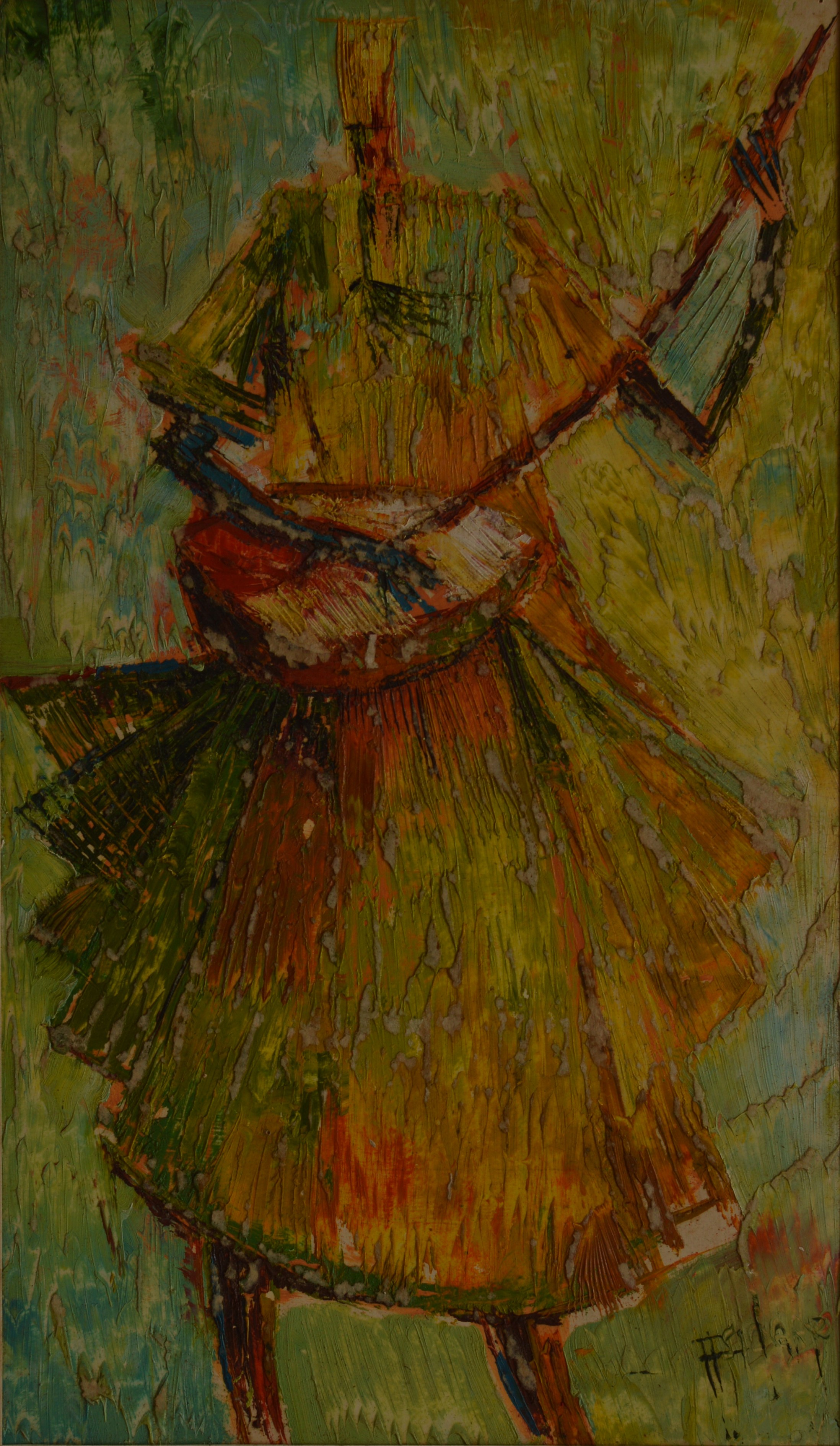
Untitled
SELECTED EXHIBITIONS
O'DA Art Gallery, Victoria Island, Lagos · Omenka Gallery, Lagos · Coronation Gallery, Lagos · Arthouse Contemporary, Lagos
NOTABLE ACQUISITION
Private collections in Nigeria, UK and internationally
Alex Nwokolo
B. 1963, Lagos, Nigeria
Alex Nwokolo arrived at the Federal Polytechnic, Auchi in 1986 already certain of his direction, and left in 1991 with the Rector's Certificate of Excellence and the American Ambassador's Award. He was part of the extraordinary cohort at Auchi that decade — alongside Sam Ovraiti, Ben Osaghae, Duke Asidere and Pita Ohiwerei — whose debut group exhibition in Lagos in 1990, Visions in Colour, announced a new sensibility in Nigerian painting: bold, chromatic, expressionistic, rooted in the Auchi school's distinctive approach. Now based in Lagos, Nwokolo has continued to evolve: his Lagos rooftop paintings — which capture the dense, rust-brown geometry of the city's skyline from above — are among his most recognisable works, alongside figurative compositions and mixed-media pieces that have taken him progressively away from the Auchi palette into territory that is distinctly his own. He has received the Society of Nigerian Artists' Distinguished Master Artist Award, and his work is held in private, gallery, museum and corporate collections worldwide.
SELECTED WORKS
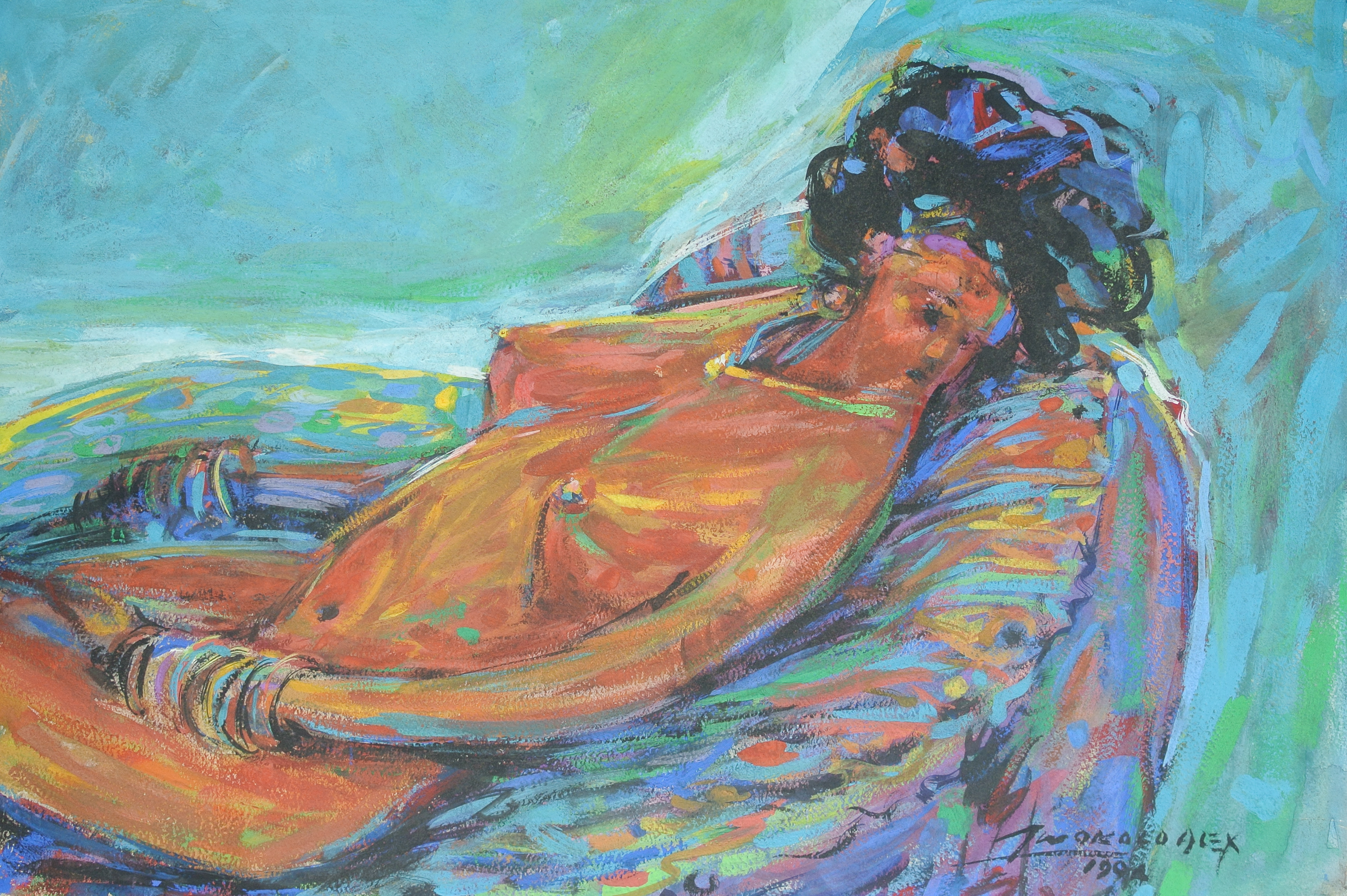
Untitled, 1994
SELECTED EXHIBITIONS
Alexis Galleries, Victoria Island, Lagos · Arthouse Contemporary, Lagos
NOTABLE ACQUISITION
Society of Nigerian Artists Distinguished Master Artist Award · Works in private and corporate collections worldwide
Pita Ohiwere
B. 1963, Nigeria
Pita Ohiwerei graduated from the Federal Polytechnic, Auchi with a distinction in painting, and was part of the celebrated Auchi school — the generation that included Sam Ovraiti, Ben Osaghae, Duke Asidere and Alex Nwokolo, and whose Colour Particularisation group transformed the Lagos art scene in the early 1990s. His most distinctive technical contribution is a method he calls scratchee — the systematic scratching of cross-hatch marks into the canvas surface to create a grainy, layered depth — which he has since extended into scrapee, in which wider sections of canvas are scraped to produce images that appear, as he has described them, slightly blurred by a rainstorm. Now based between Atlanta, Georgia and Lagos, he has exhibited widely across Nigeria, Europe and the United States, and his work has appeared at Bonhams in London. His clients have included former president Olusegun Obasanjo and Dr. Ngozi Okonjo-Iweala.
SELECTED WORKS
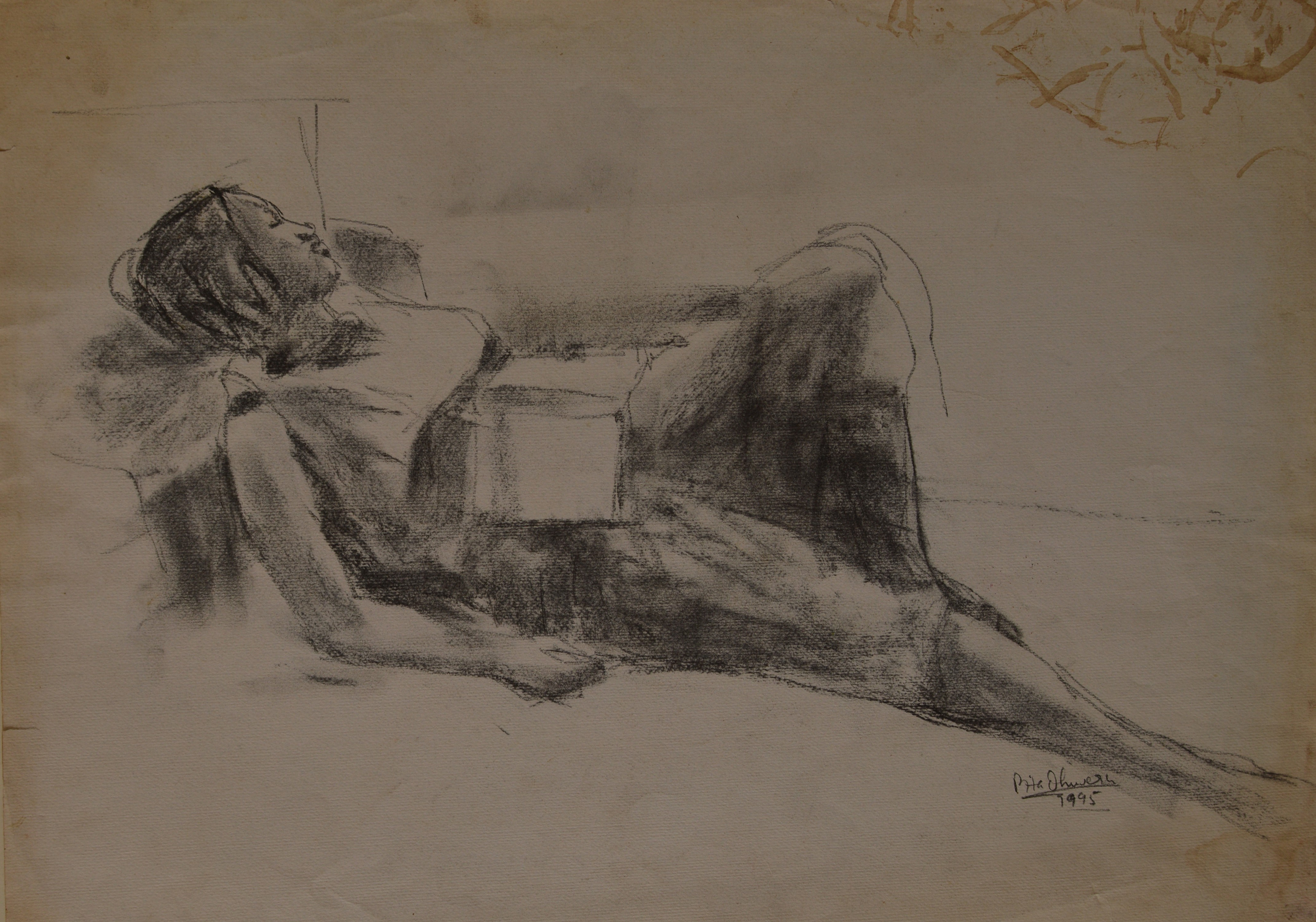
Untitled
SELECTED EXHIBITIONS
Terra Kulture, Victoria Island, Lagos · Bonhams, London · Arthouse Contemporary, Lagos
NOTABLE ACQUISITION
Private collections in Nigeria, USA, Canada and Europe
Edosa Oguigo
B. 1961, Ibadan, Nigeria
Edosa Oguigo is drawn to movement as a subject the way certain painters are drawn to stillness. Born in Ibadan in 1961 and trained at Yaba College of Technology — the Lagos institution whose painting department, built by Yusuf Grillo and sustained by figures like Kolade Oshinowo, produced a lineage of painters committed to observation and craftsmanship — he worked in advertising between 1986 and 1996 before committing fully to studio practice. His signature subjects are horses and women dancing in traditional ceremonial dress, and he has described his relationship to them in terms that echo Degas with his ballerinas or Monet with his water lilies: a sustained, loving return to a single field of movement until its essential character is understood. He maintains studios in both Lagos and Port Harcourt, served as inaugural president of the Guild of Professional Fine Artists of Nigeria from 2008 to 2012, and has undertaken annual studio residencies in London since 2011.
SELECTED WORKS
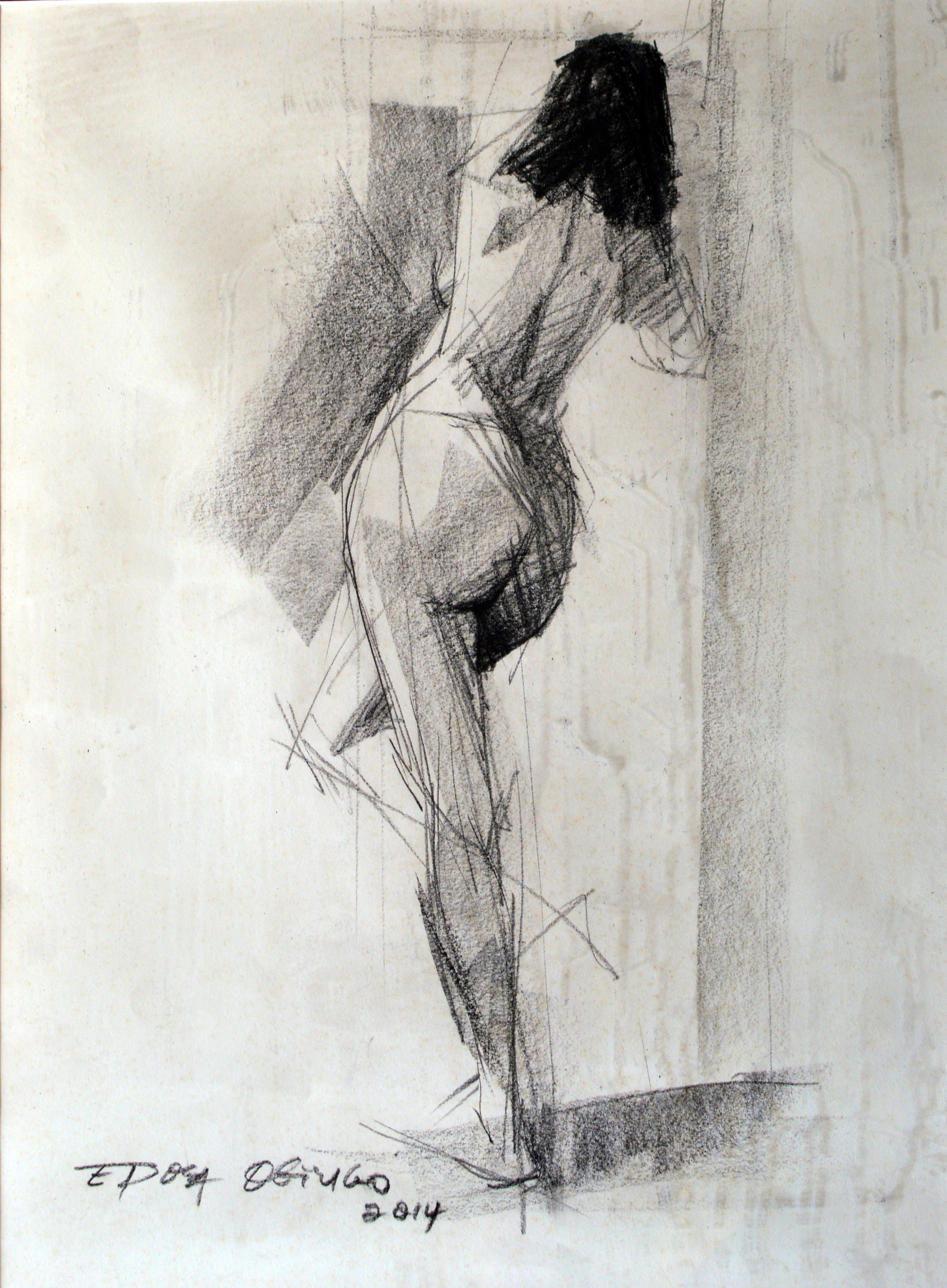
Untitled
SELECTED EXHIBITIONS
Mydrim Arts Gallery, Ikoyi, Lagos · Legacies of Biafra, Brunei Gallery, SOAS, London, 2018 · Morémi, Nigeria, London and New York, 2019
NOTABLE ACQUISITION
Guild of Professional Fine Artists Nigeria (inaugural president, 2008-2012) · Private and corporate collections worldwide
George Edozie
B. 1972, Enugu, Nigeria
George Edozie trained at the University of Benin — the institution in Benin City that has trained a significant strand of contemporary Nigerian artists including Tega Akpokona, who also holds a major place in this collection — graduating in Fine and Applied Arts in 1996, and has since built one of the more internationally visible careers among his generation. His paintings are characterised by angular figures and dense, layered textures, working across themes of love, belonging and the social and political pressures of contemporary African life. He also works across installation and found material, and has curated over thirty exhibitions in Nigeria, the United States, France and the UK. He co-authored 101 Contemporary Artists, A Celebration of Modern Nigerian Art in 2010. His work is held by the Museum of Contemporary Art in North Miami, the Indianapolis Museum, the Studio Museum Harlem in New York and the Pan-Atlantic University Museum in Lagos.
SELECTED WORKS
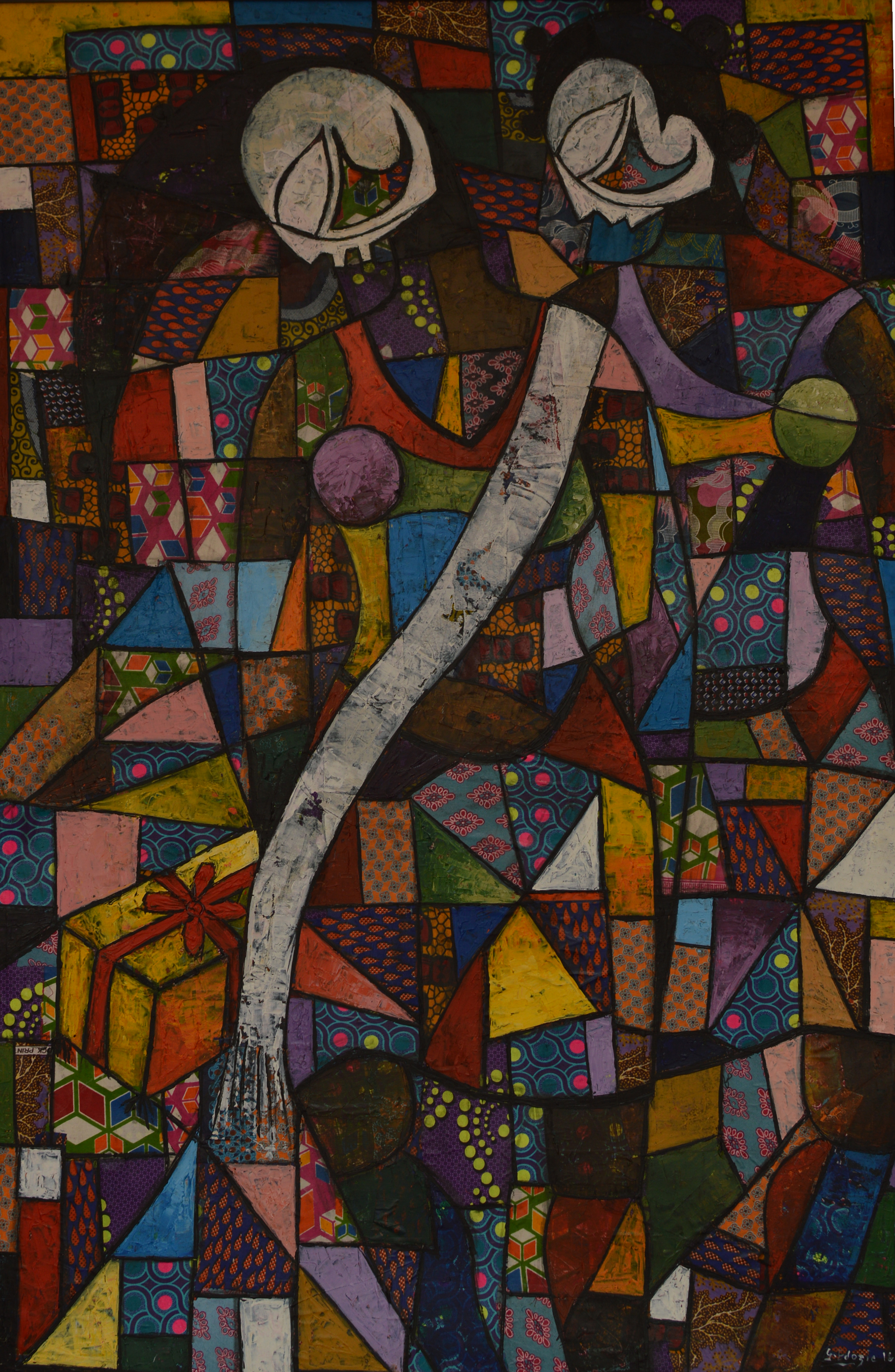
Untitled
SELECTED EXHIBITIONS
National Museum Lagos · Art Basel Miami (2017) · La Galerie Vendome, Paris · World Bank, Washington DC (2008)
NOTABLE ACQUISITION
Museum of Contemporary Art North Miami · Indianapolis Museum · Studio Museum Harlem, New York · Pan-Atlantic University Museum, Lagos
Tega Akpokona
B. 1991, Benin City, Nigeria
Light is the subject of Tega Akpokona's paintings as much as any figure that moves through it. Born in Benin City in 1991, Akpokona graduated with a BA in Fine and Applied Arts from the University of Benin in 2011 — the same institution that trained George Edozie, also represented in this collection — before spending formative years under the mentorship of master painter Abiodun Olaku in Lagos. Through Olaku he entered the Yaba school lineage: a tradition of disciplined observation and mastery of light that connects directly to Yusuf Grillo and Kolade Oshinowo. Akpokona shares Olaku's conviction that light is not a stylistic device but the primary substance of painting itself — a view that draws both men into the company of the Dutch Baroque masters Akpokona openly reveres. Yet his figures are entirely, insistently contemporary: fictional Black characters placed in settings that fuse nostalgia with the present, their faces rendered with a chiaroscuro so deliberate it elevates them toward something between portraiture and icon. The Udoaka Collection holds nineteen of his works — the largest single-artist holding in the collection.
SELECTED WORKS
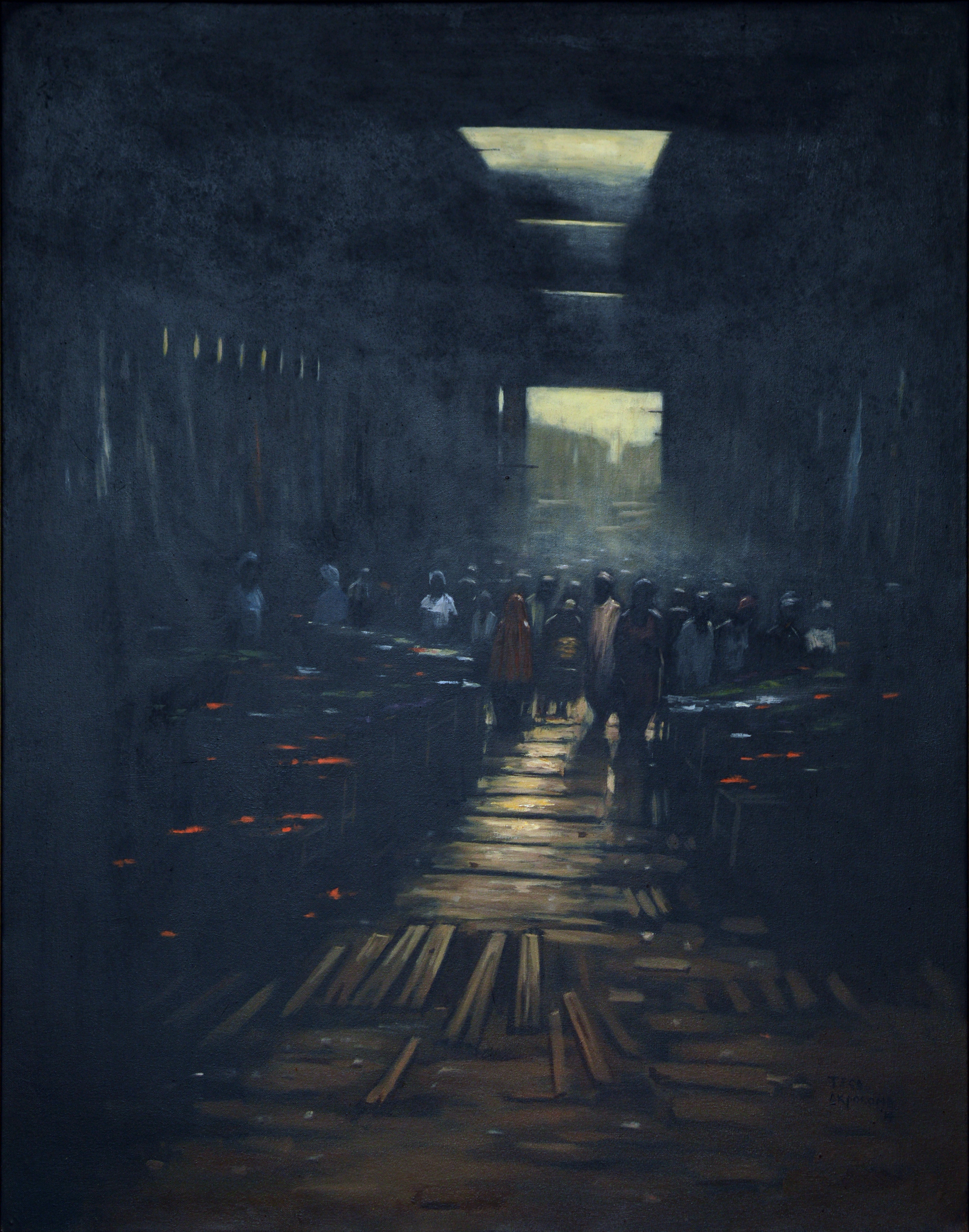
The way we are, 2014
The way we are, 2014
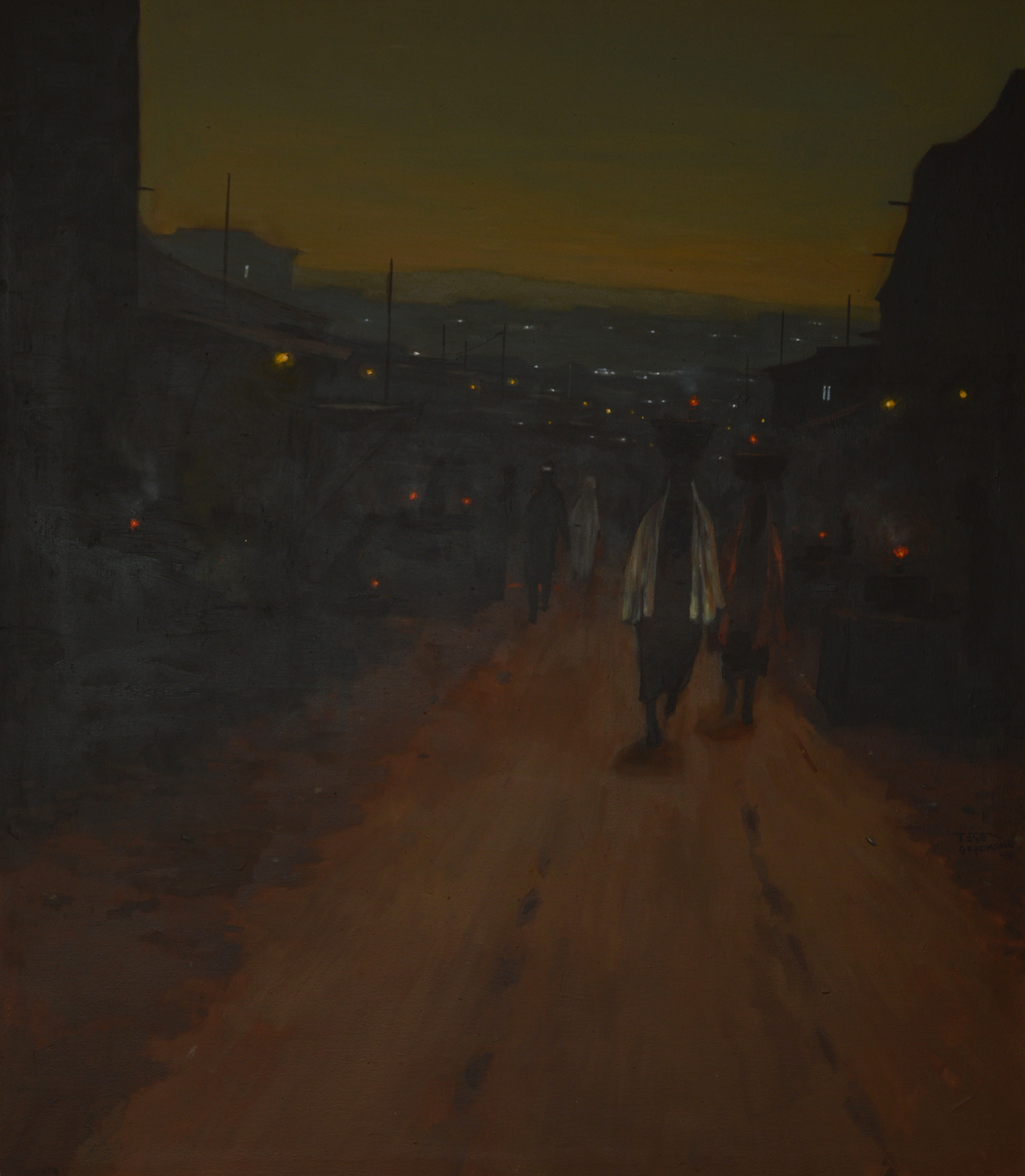
Night Shift Peddlers, 2014
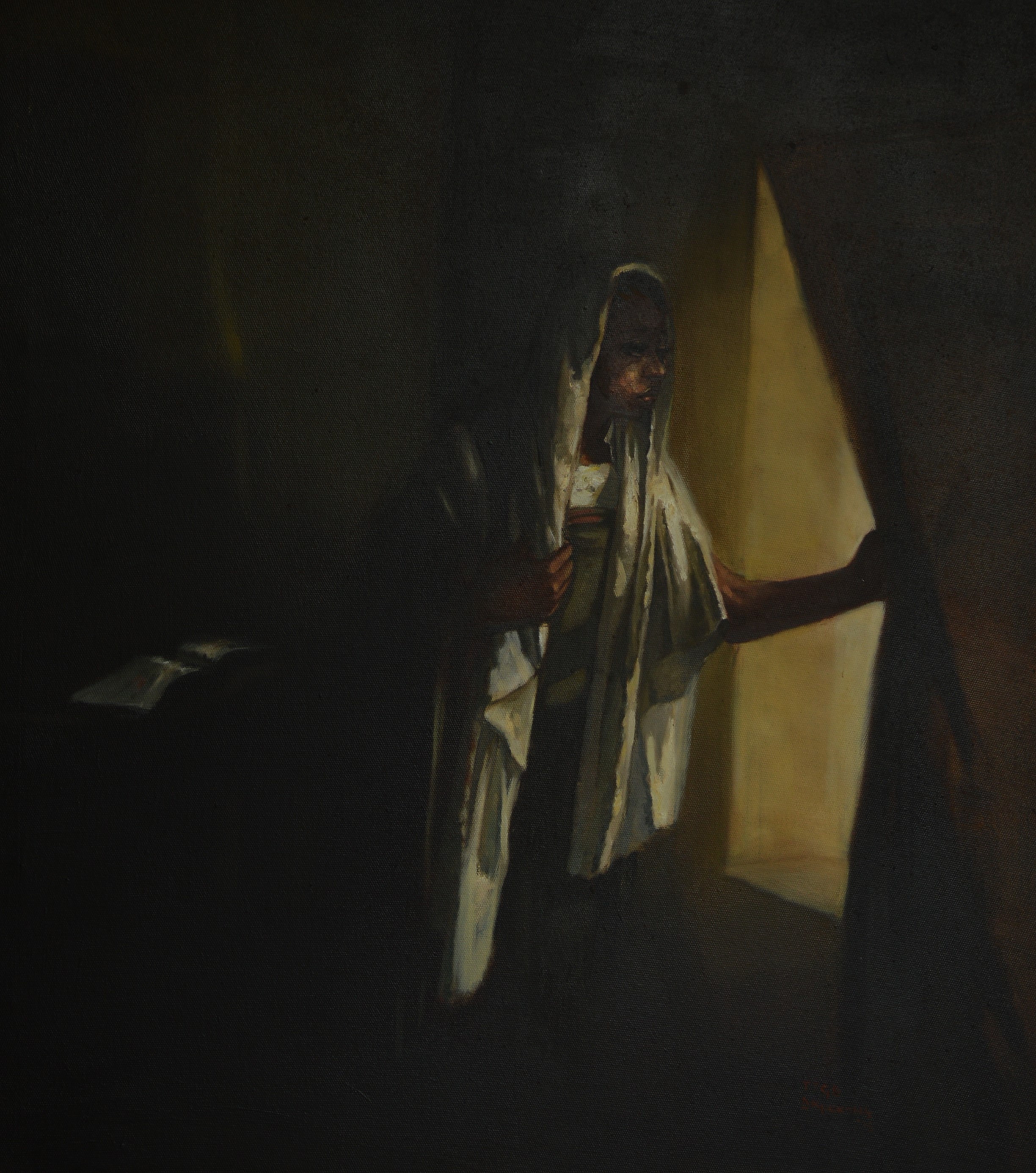
Act of Defiance, 2015
SELECTED EXHIBITIONS
Terra Kulture, Lagos, 2016 · PM/AM, London · Art X Lagos, 2018 & 2019
NOTABLE ACQUISITION
Private collections in Nigeria, UK and USA
Emmanuel Mbanefo
B. 1960, Onitsha, Nigeria
Emmanuel Mbanefo works in the register of the sacred and the communal — two categories that, in the Igbo world he comes from, were never really separate. Born in Onitsha in 1960 and trained at the Federal Polytechnic Auchi in Edo State — the institution that over the following decades would become one of Nigeria's most influential art schools, producing a generation of painters that reshaped the Lagos scene — Mbanefo established his Destiny Art Studio in Onitsha, a workshop that became as much a school and meeting place as a production space. His work centres on masquerade iconography, Igbo symbolic language and the philosophical categories of Onitsha civic and spiritual life. Masquerades, he has said, represented the legislative, judicial and executive arms of Igbo governance before colonialism — they were the law made visible, the community speaking with one embodied voice. The Udoaka Collection holds fifteen works across multiple media that together constitute an unusually rich cross-section of his practice across three decades.
Several works by Emmanuel Mbanefo previously held in the Udoaka Collection have since been placed in private hands. His biography and remaining works are preserved here; the collection continues to hold a significant body of his practice.
SELECTED WORKS
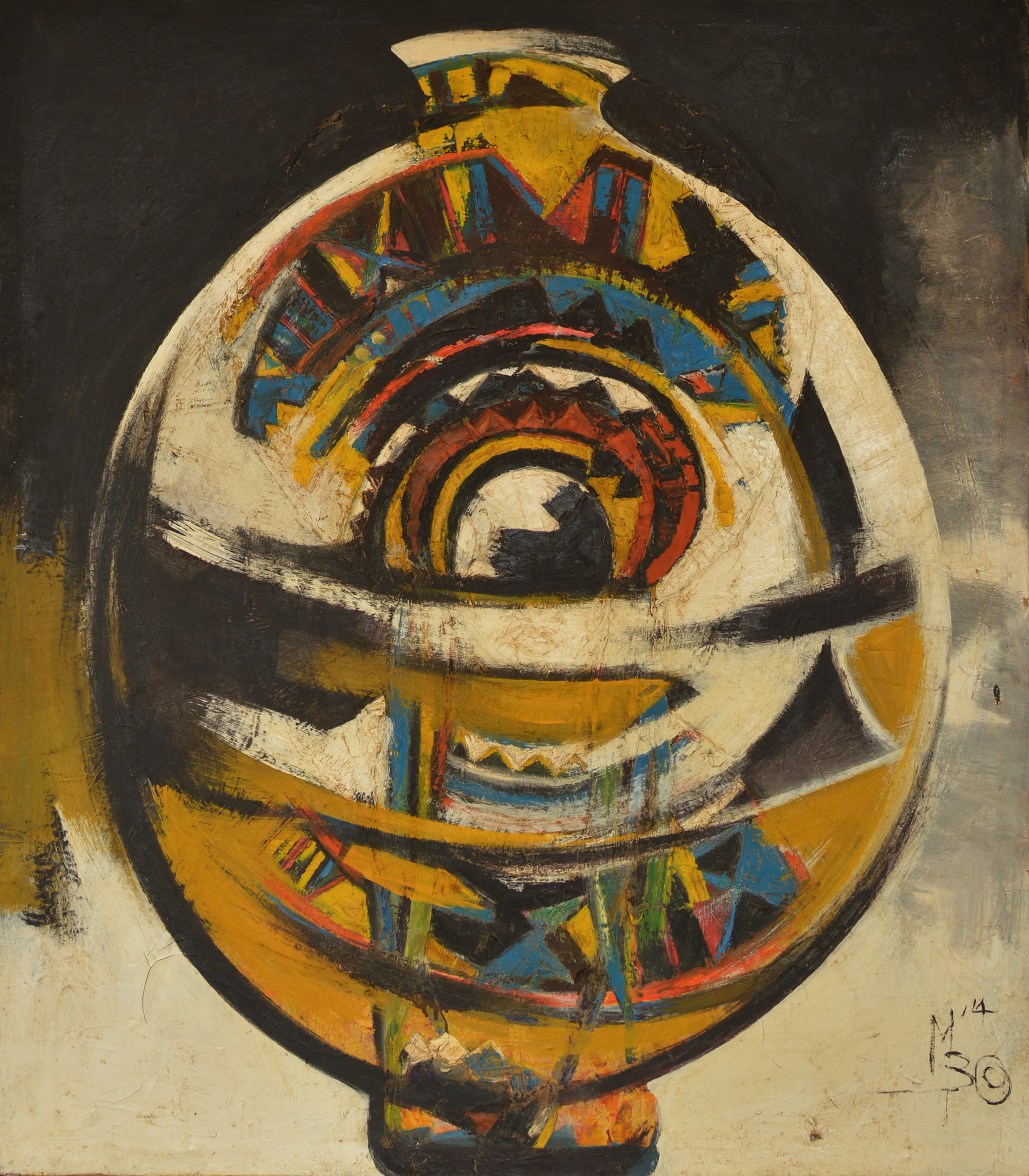
Untitled, 2014
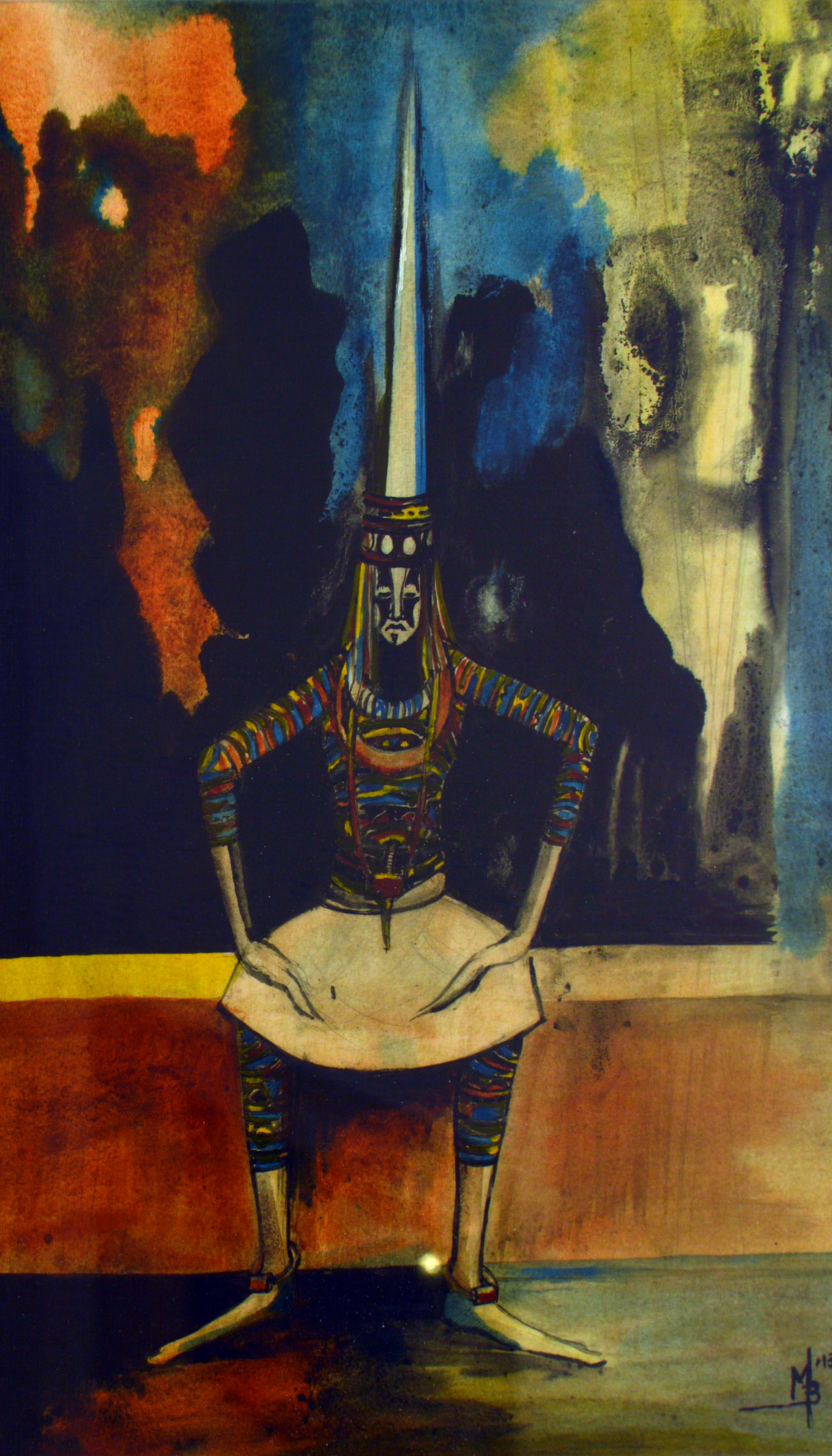
Untitled, 2010
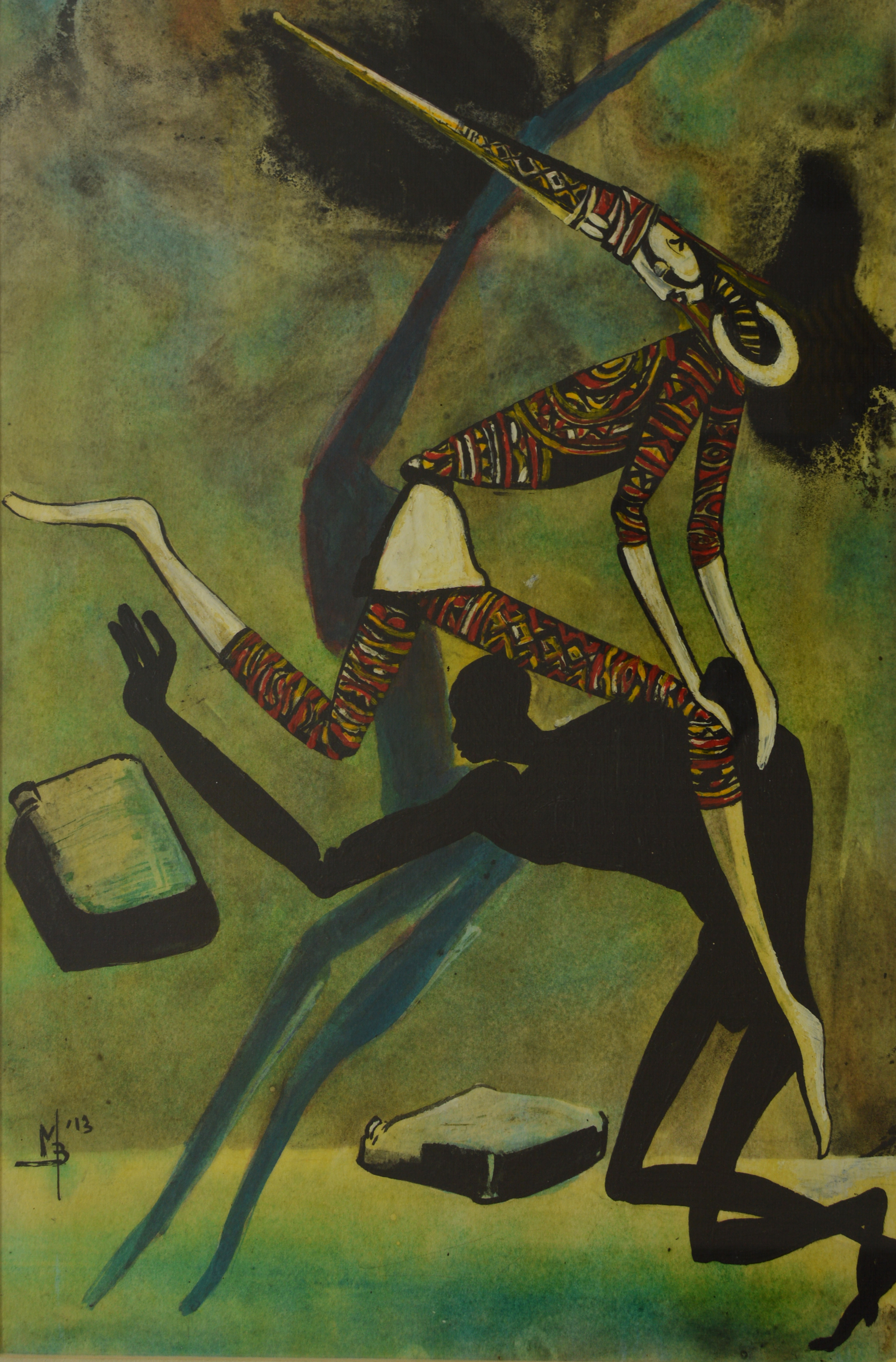
Untitled, 2013
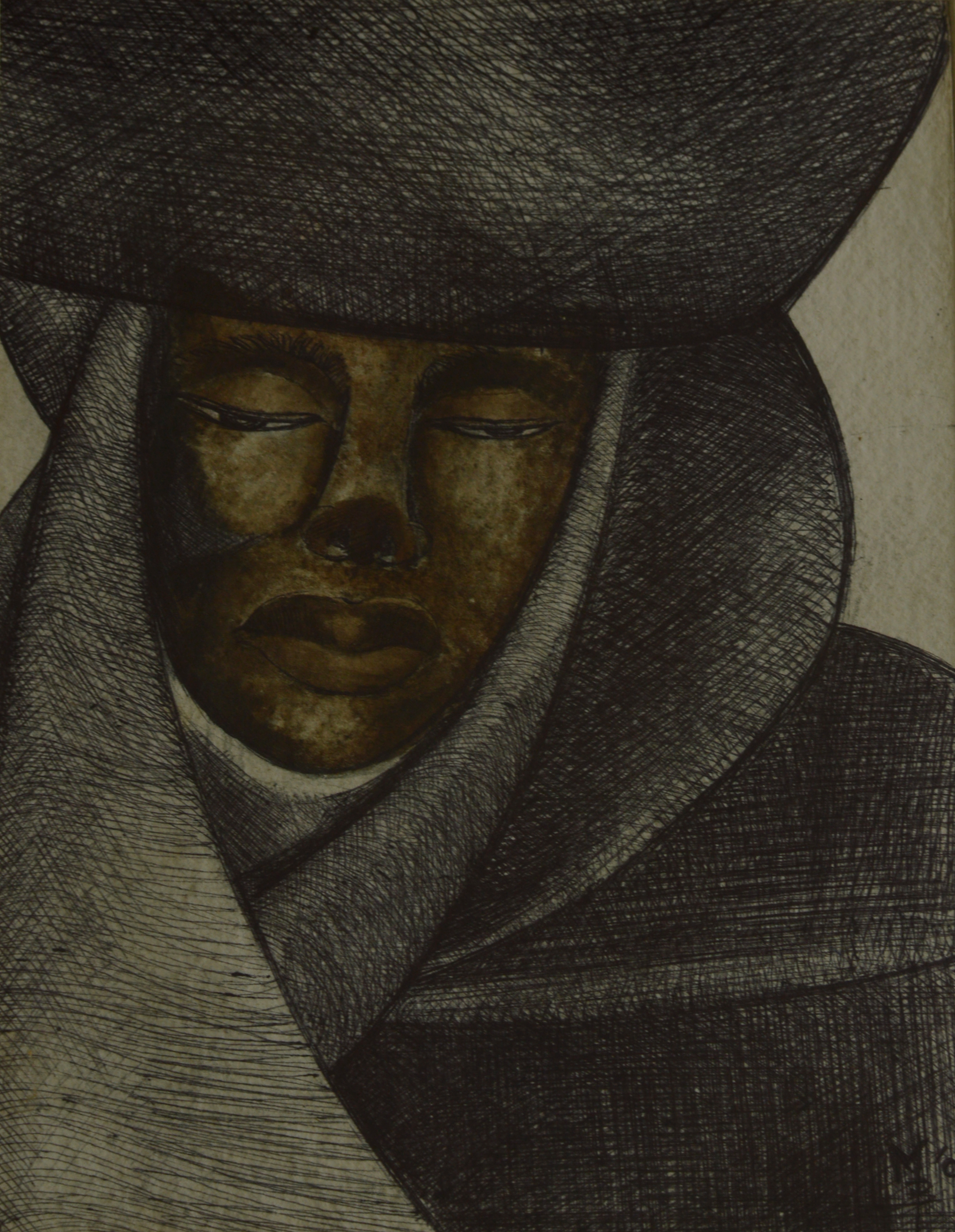
Untitled, 2008
SELECTED EXHIBITIONS
Destiny Art Studio, Onitsha · Society of Nigerian Artists exhibitions
NOTABLE ACQUISITION
Private collections in Nigeria